Communication: It Can Make or Break You

March 8th, 2011 by Nick Jacobs 309 comments »
This might be one of those blog posts that you cut and paste to forward to your friends, family, peers or boss …or you may forget that you read it as soon as you have finished it. My experiences in healthcare leadership have placed me face to face with thousands of people who communicate in remarkably different ways. It has been my experience as a non-medical, non-scientific professional that the majority of the communication problems that exist in the workplace seem to be rooted in the nuances between only two of the four basic personality types.

We often hear statements like “He just doesn’t understand me.” “We are talking about the same thing, but she is on a totally different wavelength.” “I just don’t trust him. He embellishes the truth.” “What do you mean by the word, ‘is?’” Although we might drive the same make of car, live in somewhat similar homes, read the same newspapers (whether in print or on an LCD screen) and even enjoy Lady Gaga, we sometimes really have challenges with communication.

Bridging the communications gap - Nick Jacobs, FACHE - HealingHospitals.com
These differences can come from the styles of training, education, or upbringing that we’ve had. Whatever the case, it is real, and honestly, it can be maddening for both sides. One personality type sees the world as completely filled with opportunities. Of course they recognize that there are mountains to climb, but they also embrace the fact that there are hundreds of different paths leading to the summit, and that no one way is the absolute right way to get there. These are people who, when given all of the reasons in the world why something won’t work, can find ways to legitimately avoid those obstacles and make it work. Remember, “There’s a pony in there somewhere.”

Like the creator of the DiSC personality profile, let’s call these people the high “I’s: Initiative, influential, inspiring, impressive, interacting, and interesting.” They tend to accentuate the positive, eliminate the negative, and “Don’t mess with Mr. In-between.” They often do not embrace exact detail because to them it usually doesn’t matter. Theirs is a broad picture painted with pastels that blend easily into one another.

If you are a very meticulous person, both intellectually and emotionally, it is not uncommon for you to want things to be as perfect as they can be. This does not mean that neat people or conscientious people should be categorized in any way because multiple types can have these traits, but if you notice your neighbor on his stomach hand trimming the grass blade by blade with tiny scissors, be worried, my friend, be very worried. Let’s call these people the high “C’s.” They are conscientious, cautious, compliant, correct, calculating, concerned, careful and contemplative. They are the detail people. These are the folks who can discuss the use of one word in a sentence for hours. They represent the Faculty Senate, so to speak.

Without stereotyping anyone, let’s consider the person who made straight A’s all through school. They sometimes become obsessed with those A’s, and would go to almost any length short of cheating to make them. To a valedictorian, an A minus can represent a form of failure. How does this perfection addiction impact their thinking over a lifetime? Where do communication points break down with this type of “no one can do it better than me,” souls? When is enough enough as points are made and subjects are explored. If we don’t know the grading scale, we must continue to push the topic until we feel that it has been completely exhausted. This type of perfection can drive the “We live, we love, we die” people absolutely crazy.

In order for things to make sense to the “Cs,” everything must be linear; your sentences, your thought patterns, your decision making must all be orderly and logical. Black and white and perfection are usually the only things that will bring them comfort. Even with that, they many times will revisit the issue, question it again and again, and then let the person with whom they are attempting to communicate know that they are at fault because their communication techniques don’t match their C needs.

Another trait of these individuals is that they are usually risk averse, and, if you don’t answer them based on their detailed perfection level, some will consider you foolish or untruthful. So, how do we find the common ground?

Let’s face it. Communication can make or break a company, can ignite relationships …or end them. Neither group are bad people, we are just different, and goodness can and does come from both personality types. So, what is the answer to these communication problems?

First, we must recognize and then celebrate these differences. It is absolutely critical for us to find comfort zones and then to celebrate them. An “I” personality answer like, “We’ll figure it out,” may not be what the detailer is seeking, but it certainly is a valid answer. On the other hand the I’s could go that extra step to try to provide the “C’s” with what they feel will meet their needs (in as complete detail as possible).

And if you’re on the other team, make a solemn vow not to avoid the dreamers because a lot of science emanated from science fiction, and they are often times our creators, our artists, and our miracle workers.

So, as we “embrace the differences,” remember that it does “Take Two to Tango,” and that one of you can be creative while the other can strive for perfection. A team like that will never be caught short. As Steve Jobs said, “Your time is limited, so don’t waste it living someone else’s life. Don’t be trapped by dogma – which is living with the results of other people’s thinking. Don’t let the noise of other’s opinions drown out your own inner voice. And most important, have the courage to follow your heart and intuition. They somehow already know what you truly want to become. Everything else is secondary.”

In closing, it was Einstein who said, “Imagination is more important than knowledge…” So, let’s all imagine a better world, a world that is not run and controlled by the economists, but one that embraces the passions of our hearts and our emotions.

We really can have it both ways.

Share

My Shortest Blog Post Ever

March 2nd, 2011 by Nick Jacobs 14 comments »

From Modern Healthcare:

The Thirteen Top States

7,345,000  California

6, 433,000  Texas

4,118,000  Florida

2,837,000  New York

1,985,000  Georgia

1,891,000  Illinois

1,685,000  North Carolina

1,643,000  Ohio

1,409,000  Pennsylvania

1,371,000  New Jersey

1,350,000  Michigan

1,273,000  Arizona

1,014,000  Virginia
__________________

27,744,000 Total

The Other 37 States:

16,036,000
__________________
43,780,000 Grand Total

This is, by far, the shortest blog post I’ve ever written.

As a self-proclaimed patient advocate, this blog is dedicated to those 43,780,000 people that the numbers above represent.

THEY ARE THE UNINSURED IN THIS, THE WEALTHIEST COUNTRY IN THE WORLD.

Share

It’s Not Just About the Passion

February 20th, 2011 by Nick Jacobs 1 comment »

Get up at 3:00 AM, get to the airport at four, fly out at five, arrive in Austin, Texas at 10:20 AM, wait until 1:30 PM to meet three other board members, rent a car and drive to the retreat center. Check–in, have a quick dinner and go to the first evening board meeting; in bed by 11:30 PM, up at 6:30AM and meetings on Saturday until 11:00 PM. Next day: Up at 6:30 AM, meet until 10:30 AM, drive to the airport and fly home through multiple cities; arrive at around 8:00 PM. That was my weekend. Why? Because I am the only non-physician member of the American Board of Integrative Holistic Medicine. More specifically, I am the not-so-token former hospital administrator, and that’s how much ABIHM cares about spreading the word.

This is my third year as a board member, and during that time, it has been my genuine pleasure to watch this amazing group of caring, integrative/holistic physicians build what is fast becoming the most important element in the U.S. healthcare reform movement. Most of them may not be seeing this the same way that I am (i.e., as not only life but also economic saviors), but it is absolutely a fact that their way of providing care is the only hope that we have in this country to contain health care costs and improve the quality of life in America.

As physicians, this group of humble yet brilliant men and women are true giants in their respective fields of endeavor, be it Family Practice, Internal Medicine, OB/GYN, or Psychiatry. They are “top docs” in combining traditional practice with integrative and holistic medicine. They come from prominent medical schools, and some eve teach residents at these schools. Some are in private practice and still others are working for large, prestigious health systems. They have literally written many of the books on integrative and holistic medicine, but the most important thing that I can tell you is that they are all unbelievably positive people; kind, caring, nurturing, thoughtful human beings who are “in it for all the right reasons.” No kidding. All of them.

Why am I so enthusiastic about these folks? They truly practice what they preach. Spending even 50 hours with them revives the soul and confirms my beliefs that every one of these holistic modalities can contribute to our well-being. I’ve heard their stories about the power of meditation, of vigor restored by appropriate diet and things like simple yoga stretching and walking. They casually discuss case after case of people who have been cured or healed of what would otherwise be considered debilitating maladies simply by altering a diet; cutting out the processed foods and sugars, walking a little every day and finding anywhere from 20 to 40 minutes a day to just step back and focus on themselves, their hopes, dreams and positive outcomes through internal journeys of self-exploration and meditation.

So, where do we go from here?

If you’re a doctor, look them up on the web at integrativeholisticdoctors.org, attend their seminars and workshops, meet them, learn about their peer mentoring program, embrace them and their 1200 Diplomates, and, most importantly, get on board. Each and every one of these gifted, inspired physicians has one thing in common: they love their work; they love to go to work, and their patients and staff love to work with them. If for no other reason, look them up for yourself.

If you’re a patient, don’t settle for less. Search their website at and find physicians near you who are certified in Integrative Holistic medicine. Get off those medicine cabinets full of pills, start taking care of yourself, and begin to live the life that you and your loved ones deserve. It’s the only way. The promise of technology has not cured us. The skill of steel from our gifted surgeons has not prevented the malady from impacting us in the first place, and, finally, the pain and suffering keeps going on and on in our lives.

The solution? Find an ABIHM doctor and start the change today.

The American Board of Integrative Holistic Medicine (ABIHM) is pleased to announce an additional opportunity to take the 11th Annual Board Certification Examination, on-site at the conclusion of the iMOSAIC Conference in Minneapolis, MN.  Please take a moment to review the iMOSAIC conference schedule at www.imosaicconference.com, where you will see an impressive program of faculty and topics!

Date: Sunday, April 10th, 2011 at 1:30 PM. Sign in between 1:00-1:30 (preregistration required).

Location: Minneapolis Convention Center, Room 208 AB

Duration: 5 hours allotted; at least 50% of candidates finish by 2.5-3 hours

Share

Medical Homes – Defining What Patients Want

February 13th, 2011 by Nick Jacobs 75 comments »

The definition of a medical home can be confusing to those who have not been dedicated students of this terminology. As the medical home concept has been added to the healthcare landscape of  the U.S., many uninformed healthcare professionals look at each other and shrug as if they seem to expect to see villages being built with work-out facilities and critical care equipment as part of the accoutrements. Instead, the concept of the medical home (also known as the Patient Centered Medical Home – PCMH) refers to patient-centered care, a phrase that we and Planetree have been using for over thirty years.

Imagine a physician’s office or clinic where the patient’s records are reviewed prior to each visit to ensure that the necessary immunizations, tests and wellness milestones are in place and accounted for on a consistent basis. If that stretched your imagination, consider a medical support staff that communicates by secure e-mail and phone to organize the patient’s care. Add to that an electronic medical record system that tracks the patients, their tests and prescriptions. That is just the beginning of what a medical home could be and do.

One of the companies with which SunStone Management Resources is working goes so far as to add nurse- patient advocates to the mix and then assigns them to help sort through the morass of decisions every person faces with significant co-morbidity risk factors. This system not only helps the patient, it holds down costs by giving people a stable, well-coordinated patient centered medical experience. As an advocate, I believe that it will be key to stopping the loss of billions of dollars in unnecessary treatment costs that conversely leaves millions of our citizens without appropriate medical care.

These outcomes can only be achieved by developing years-long, longitudinal relationship with the primary care provider and their team, and with patient advocate nurses who are assigned to work with those teams to help sort out the redundant tests and medications that often evolve from interacting with as many as nine different specialists each year. This number of hands usually results in at least 15 office or clinic visits and countless unnecessary tests. Imagine how great it would be to have someone who can lead the patients more efficiently through this journey.

In a recent edition of Modern Healthcare, Andis Robeznieks wrote an article entitled “In Search of Medical Homes.” Interestingly, it described the evolving requirements from the National Committee for Quality Assurance for medical home standards. Some of you may remember that this journey began officially in 2008. Of course, the Joint Commission and the Accreditation Association for Ambulatory Health Care were also in on the act as they began that same journey. The question posed by these organizations centers around the unique qualities of a patient-centered medical home.

Somava Stout, MD - Cambridge Medical Associates - Nick Jacobs, FACHE

Somava Stout, MD

Even though, as the article pointed out, the NCQA was experiencing success from their medical home practices business line, patients weren’t experiencing that same feeling of success, attention or comfort. According to Mr. Robeznieks this fact was eagerly confirmed by the patients as they filled out their patient satisfaction scores. The piece went on to outline the latest and greatest revisions to the NCQA standards which included, heaven forbid, a stronger voice from the patients. My favorite quote from the article was from Dr. Somava Stout, Vice President of Patient–Centered Medical Home Development for the Cambridge Health Alliance: “One of the things we do over and over again in healthcare is we don’t remember to include the patient as a partner in designing the (personal ) healthcare system.”

In summary, medical homes would provide patient-centered care that results in reduced visits to specialists and allows less expensive primary care doctors to care for the majority of people’s health care needs. This in turn would result in higher quality outcomes with greater patient satisfaction and more funds to take care of the under insured.

Sounds like a plan.

Share

Veratherm

February 3rd, 2011 by Nick Jacobs 56 comments »

For the past 25-plus years, my personal commitments, both intellectually and emotionally, have been directed toward helping to make positive changes in the healthcare system worldwide. It’s been my great pleasure to have had the opportunity to connect with such organizations as Planetree, and to work with them to enhance and promote their philosophy of integrative medicine and human touch. We have watched them grow from three to more than 600 affiliated hospitals. It has also been exciting to have had the chance to work with organizations like the American Board of Integrative Holistic Medicine (ABIHM), a truly transformational healing organization. Their laser-focused goal is to reach more and more physicians worldwide to assist them in becoming certified in the techniques of holistic and integrative healing arts.

Along with these high-touch organizations, I’ve also been privy to advancements and discoveries made within the research field. As a former hospital CEO, and Founder of a medical research institute, I have been exposed to both the peaks of promise created by medical technology and the valleys of disappointment that have evolved from those unfilled expectations generated by the promises of that same technology.

Veratherm - ThermalTherapeutic Systems, Inc. - Nick Jacobs, FACHE

The subject matter to be addressed in this next blog segment is not a false promise. This particular medical device, the VERATHERM™ system was designed, patented and FDA-cleared as a portable hyperthermic perfusion system. There are two other FDA-cleared devices that have been used for this procedure – one which has been retrofitted and the other is somewhat outdated. There are also experimental-type devices that have been pieced together for use in some research facilities and academic medical centers, but they are not FDA-cleared and cannot be marketed.

What VERATHERM™ does provide is a very real opportunity for surgeons and perfusionists to not only standardize hyperthermic perfusion in the treatment of cancer but, potentially, to help to significantly extend the lives of those patients touched by these surgeons and the use of this technology. Most recently, I have had an opportunity to not only see this medical device but also to work with the extremely passionate individual who is in charge, Raymond Vennare, CEO of Thermal Therapeutic Systems, Inc. Raymond has helped to develop and bring to market this compact and mobile perfusion system that, I believe, will contribute to helping literally hundreds of thousands of people worldwide. In my exploration of hyperthermic perfusion, however, I have discovered that only a tiny fraction of those patients who could be helped by the technique that is enabled through the use of this device have any idea that it even exists. Hence, the reason for this blog. VERATHERM™ not only does exist, but the procedure performed by these surgeons and perfusionists can also have a dramatic impact on certain types of cancers.

Please understand that my interest in hyperthermic perfusion in the treatment of cancer revolves around a commitment to those individuals – people like my father, and Raymond’s father, mother and brother who, because products like this were not available, were all lost prematurely due to different types of devastating cancers.

How does this work? After complex surgery for the removal of the tumors in specific body cavities, such cancers as the colon, appendix, stomach, lung and even some types of metastatic breast cancer, the appropriate fluids can be heated in order to perform an intraperitoneal or intrathoractic lavage. These heated fluids then are circulated through the impacted body cavity as needed to help eradicate any remaining cancer cells. Sensors and probes built directly into the VERATHERM™ Console and Disposable Kit efficiently monitor temperature, pressure and flow of heated and unheated sterile solutions while protecting the patient, physician and profusionist.

Let me close by saying one more time that, due to the procedure enabled by this medical device, the lives of many patients have been extended by as much as three-to- five years. It’s not technically impossible to do, but, as a patient, you have to know about it to request it, and only a handful of cancer centers in the entire country have begun to even look at the creative re-use of profusion equipment for non-traditional surgical lavages such as this.

You read it here first!

The Parable of the Starfish

One morning an elderly man was walking on a nearly deserted beach. He came upon a boy surrounded by thousands and thousands of starfish. As eagerly as he could, the youngster was picking them up and throwing them back into the ocean. Puzzled, the older man looked at the young boy and asked, “Little boy, what are you doing?” The youth responded without looking up, “I’m trying to save these starfish, sir.” The old man chuckled aloud, and queried, “Son, there are thousands of starfish and only one of you. What difference can you make? Holding a starfish in his hand, the boy turned to the man and, gently tossing the starfish into the water, said, “It will make a difference to that one!”

Share

Along the Way…Things Became Very Interesting

January 31st, 2011 by Nick Jacobs 18 comments »

Two years ago I began this new journey, but not until a few months ago did my work in consulting really begin to take shape in a way that could never have been predicted.

As the challenges of our present economic times have become increasingly daunting, my personal and professional journey has become even more dedicated to innovation and creativity. One goal has been to provide new alternatives to past practices that will create value for patients. This means making a contribution to saving and transforming lives, while producing cost savings and financial stability, and developing new markets to enable provider growth in their missions.

Olympic National Park, Port Angeles, WA - Nick Jacobs, FACHE - Healing Hospitals - SunStone Consulting

The driving force behind my exploration began with asking how we can begin to control those out of control expenses that are currently blurring the lines between continued care for our population, and rationing or elimination of services?  But, the answer(s) must enable us to continue to add healing opportunities for our patients at every turn.

Because my creative energies have always been focused on producing more ways to generate new monies for whatever organizations I have personally represented,  it seemed somewhat foreign to me to spend more time on fiscal issues than creative alternatives.  However, with literally millions of Baby Boomers coming of age each year, it was obvious that our entire culture is at risk both fiscally and socially. Consequently, after listening carefully to my peers, several opportunities presented themselves that would address all levels of these concerns.

Through the combination of their proprietary software and dozens of years of combined knowledge in the healthcare finance field, SunStone Consulting, LLC, spends each and every working day addressing the challenges of finding monies that should already have been captured by hospitals and physician practices, while also creating new opportunities that have heretofore not been explored. That’s where SunStone Management Resources comes into play.

SunStone Consulting - Nick Jacobs, FACHE

We have identified new companies, new entrepreneurs and new creatives who can not only improve healthcare, but also significantly improve the bottom line of those organizations willing to embrace their programs. One such company with whom we are partnering can increase Emergency Room productivity by as much as 35 to 50%.  They can also help do the same for cancer centers and operating rooms. They utilize robotic systems that communicate patient needs and simultaneously seek out the appropriate medical services required as soon as the patient is triaged. The patient’s condition and potential requirements are communicated to every individual who will or should have contact with them throughout their hospital stay.

We have also identified what I refer to as “no brainer” opportunities. By making otherwise locked fiscal percentages  a commodity, even small and medium sized organizations can save huge dollar amounts. How? By changing out only the electronic reading devices used hospital-wide. This simple change has resulted in huge fiscal savings for clients.

Add to examples like those above the introduction of  a new invention that, in the right hands, can help to extend some types of Stage 3B and Stage IV cancer patients’ lives from months to years through a relatively simple post-surgical procedure. Also consider the invention of new materials that would support bone growth, while virtually eliminating the need for casts or even slings. Imagine a series of protocols that have brought over 40 people out of deep, irreversible comas. Then, on a completely different path, consider having access to  the cumulative knowledge garnered from over a hundred million dollar investment in breast cancer care.  (This is about to be made available to small and medium sized hospitals across the world.)

These are but a sampling of  just some of the opportunities currently driving my passion in this new healthcare world order.

You may want to make a simple inquiry into what’s behind the innovative, practical, and incredible creations of the brilliant people doing this work.  It’s not just so many words on a page.  It is the future, and the future for you and your organization could be now.

Share

Finding the Cure…for Bullying

January 21st, 2011 by Nick Jacobs 33 comments »

No workplace bullying - Nick Jacobs - healinghospitals.comThis week, NBC’s Today Show featured another story about bullying. As I have have mentioned in previous posts here and elsewhere, I believe that bullying is the quintessential cancer on our lives in places of business, in the military, politics, and relationships of all types.  The good news – actually the very good news –  is that there has been some incredible work being performed on this topic through the efforts of Dr. Matt Masiello at my former place of employment, the Windber Research Institute in Windber, PA.  Grants through the Highmark Blue Cross Foundation of Pittsburgh have fueled this initial effort and the academic and quantitative analysis being done by Clemson University has documented this work.  I believe that this joint effort is a magnificent  example of what can be done to change the future course of events currently being controlled by bullies.

The Today Show story that I saw featured the Massachusetts school where, due to cyber-bullying, a young girl committed suicide last year.  Apparently, another girl is now having the same experience at the same school. With the help of programs like this comprehensive anti-bullying program, the former Secretary of Education from PA, Jerry Zahorchak, (now Superintendent of the Allentown PA school system), embraced the effort to quell and discourage this type of destructive behavior.  And the program, under the direction of Dr. Matt Masiello has successfully been introduced across the  entire State of PA. (Matt had started the Allegheny County’s Goods for Guns program in 1994, when he was the head of pediatric intensive care at Allegheny General Hospital. To date, this program is responsible for collecting more than 11,000 illegal guns from the streets of Pittsburgh.) Matt has had the same success with this anti-bullying program. Now, both Massachusetts and Maryland are looking into embracing this effort.

This anti-bullying program is based on a European program with which Dr. Masiello had become familiar.  This is a school system-wide effort that is very well documented and results in tremendous awareness and reduction of bullying at all grade levels.

The trainers bring a group of teachers and administrators together in the school system, and then “train the trainers” as to how this effort can become part of the philosophy of the school.  They start the training in the spring, typically launch the school wide effort in the fall and run it for at least a year. During that time, detailed records are kept measuring outcomes.

Matt Masiello, MD - Windber Research Institute - Nick Jacobs - Taking the Hell OUt of Healthcare

Matt Masiello, MD

Matt is a wonderful physician, a truly giving person and a saint of a man who is the only U.S. representative on the board of the World Health Organization’s Health Promoting Hospitals program. I hired him before I left Windber Research Institute, and he has worked tirelessly to address both this problem and the problems of childhood obesity.

The Olweus Bullying Prevention Program (Olweus.org on the web, @Olweus on Twitter) has impacted more than 400 school districts and 20% of all school-aged children in Pennsylvania. It has also had up to a 50% reduction in student reports of bullying …and bullying others.

For more information, please contact me or Dr. Matthew Masiello at the Windber Research Institute.

Michael & Marisa’s anti-bullying song – “The Same”

Share

Making Sense of Tucson

January 11th, 2011 by Nick Jacobs 34 comments »

It was 1991 when one of  my professors at Carnegie Mellon University began discussing health policy in the United States.  He told us about Arizona, where the state government had decided to stop paying for transplants.  Then he went on to explain that desperate families were moving from Arizona to Pittsburgh, just so they could establish residency in Pennsylvania, and their loved one could receive a transplant.

At around that same time, an outspoken politician from Colorado, former Governor Richard Lamm, who ran for President of the United States on the Reform Party, described the travesty of Medicare vs. Medicaid.   He described the older generation as committing “generational murder” because, even though many times there was no hope  for their survival, for extending their life or for having any quality to their life, we, as a nation, spend 60% of our Medicare dollars on the last  30 or so days of life.  He advocated being honest and allowing people to decide if they wanted palliative care.

What he also pointed out was that, as a country, we continue to have one of the highest infant mortality rates in the industrial world. The reason, he theorized, was because the seniors voted and the young mothers didn’t and no politician would dare vote against that senior coalition.  (This is not about death panels, it is about honesty in healthcare. It is about transparency and explaining the facts to the families so that they could make rational decisions.) None of his words were well received, but nevertheless, they were filled with candor and embraced very difficult ethical views.

Giffords Tucson tragedy - Nick Jacobs, FACHE - Healing Hospitals

The bottom line?  It is a very sad situation when we have to, in effect, sentence people to death at any age because resources are not available to save them, but this is emphatically not about rationing of care, because rationing infers giving everyone a little less.  This is about making a government decision to take away everything. So, this is about making rational  resource allocation, not based upon the number of votes needed to get re-elected, but based on the value of a life at any and all ages.

Finally, the elephant in the room?  Those people killed and wounded in Arizona were killed and wounded because of a man who is most likely mentally ill.  We, as a country, must begin to address this mental health issue with parity, with commitment and without judgment.  No family is without some member who is suffering from some mental health issue, but  this discussion is still ignored, hidden or buried.

So, when the pundits ask if it is about the rhetoric? We don’t know. When they ask if it is about the availability of weapons and ammunition?  The answer seems to fall under that same category. BUT, when the question is properly directed toward mental health?  The answer seems to be absolutely, yes without a doubt.

During this time of reflection, let’s get serious about the very real and very big challenges that this nation faces. We must, as a nation, take these challenges head-on and deal with “problem solving,” and if this Congress does not begin to take action and begin to solve problems, then we must vote again in May and November to continue to make our voices heard.

Unless we can begin to talk with each other with dignity and respect, we will not make progress.  Until we begin to respect the other person’s point of view and understand that debates are healthy again, we will not make progress. Our leaders need to debate, but at the end of that debate, it is essential that they walk out of the room together and agree that they are all here to do a job, and that job is to solve problems.

My heart goes out to all of those families who were impacted by this awful tragedy.

Share

Warm Memories During The Holidays

December 19th, 2010 by Nick Jacobs 23 comments »

On those snow-covered roads of the 50’s and 60’s, the drive to my grandparents was always unforgettable. It seemed that the roads were hardly ever plowed, and there was no salt – just those coal black ashes mixed with tiny pieces of metal that would puncture a tire at least once or twice each winter.  The trip to their house really was over the river and through the woods, as we crossed the old wooden plank bridge, and started up the back roads to the park, where they lived.

Dad was not shy about winter driving on snow drift covered roads. As we slid and crashed through the white stuff on those old, back country roads at breakneck speeds, he would laugh as if nature was just something with which to play. Rear wheel drive in those clunky old 50’s cars was just crazy fun, as the Buick turned into a high tech, machine powered sleigh.  We would drive into total isolation where no unchained car had gone before us and thrill at making those first tire tracks in that freshly fallen snow. Mom would always be yelling, “Be careful, Charlie, don’t go too fast,” but he just laughed that baritone laugh as he put the pedal to the metal.

Winter, mid-1950s - Nick Jacobs, FACHE

After our snow driving fun, we would have our snow playing fun as we romped and rolled in the snow in our grandparents’ yard. That could go on for hours or until our blue jeans were completely frozen. Then we walked like icicles toward the heat of grandma’s kitchen. We were so cold that even our long underwear was frozen. In fact, we looked like cold, hard kid-cicles.  Once inside we would peel off layer after layer of wool and cotton until we were down to our frozen long  johns.

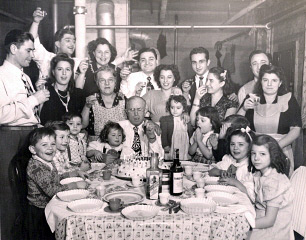
Our grandparents’ house was a place where we were surrounded with more fun, love and craziness than a kid could ever imagine. Oh, and food?  There were pots and pans bubbling and jumping on every burner of her old gas fired stove; spaghetti, meat sauce, home grown vegetables, cookies, and every type of Italian fruit or vegetable. In the middle of the table there was always a bowl filled with black gold, those wonderful fat, black olives that became candy to me. When the spaghetti was finally put on the table it was in a serving dish that reminded me of a soup bowl for Jack and the Beanstalk’s Giant. It could have been a bassinet for triplets. There had to have been at least two or three pounds of specially cooked pasta just waiting to become part of our collective muffin tops!

After we said grace (during which Grandma could be heard mumbling in Italian under her breath), Granddad would pass the wine around the room to all of the adult males at the table.  His philosophy as he poured his homemade wine from the gallon jug was that warmth, laughter, love and fun came from the fruit of the vine.  Throughout the entire meal, they would drink and laugh and sing to the tune of those carefully-cultivated grapes.  I loved the lighthearted, happiness of those meals. We never talked about anything serious and if anyone tried to bring up a serious category, granddad would do something just plain crazy like dump his peaches into his coffee cup, and my Grandmother would begin her ritual, a ritual that she surely seemed to enjoy as she scolded him by yelling out, “Patsy, Patsy, you gonna make-a da boys be bad!”  He would smile with that knowing smile that seemed to say, “Oh, they’ll be bad, alright, but not because of tonight. It will be because they have my genes!”

We loved the hugs, the love and the laughter. We always left there feeling that total nonjudgmental, complete love that only a grandparent can give.

It was all about that love.

Share

Wikileaks and Transparency

December 9th, 2010 by Nick Jacobs No comments »

LONDON (Dec. 8th) —Held without bail in Wandsworth prison, Julian Assange has been deprived of his trusty laptop, so the WikiLeaks founder can’t supply an inside scoop on life behind bars. But if the pro-transparency campaigner could leak just one word about conditions in Britain’s biggest jail, he would probably settle for “cramped.”   (via AOL NEWS)

Wikileaks' Julian Assange at TED - Nick Jacobs, FACHE

At my last CEO position, there were about 650 employees on the hospital side and another 50 at the research institute, but in the position that I held as the Chief Communications officer immediately before that,  there were over 4,500 employees.  Any one of those employees could  potentially have become PFC Bradley Manning.  Manning is the young man being accused of leaking millions of pieces of information to Assange’s Wikileaks. Every disgruntled, well-intentioned and sometimes naive employee who either had an “axe to grind” or who simply embraced a philosophy of openness would have potentially presented a major problem to any organization that was built around secrecy at all costs.

In my 20+ years as a hospital administrator, there were hundreds no, thousands of incidents that could have been “leaked” to family, friends and the media regarding incidents that may or may not have been problematic.  My memory goes immediately to an online discussion forum where the death of Congressman John P. Murtha was being dissected by a group of Bethesda Residents;  specifically, young U.S. Navy physicians who were venting and expressing their fears regarding their “being held responsible for the death of this powerful Congressman.”  The amazing thing to me was the it was a running dialogue that was, yes, online. The discussion topic thread was etitled Did we kill Congressman Murtha? The anonymous user names went through case-by-case analysis of other undeserving patients who did not emerge with their lives from surgeries at the hospital over the previous weeks and months.  These were individuals who, according to their estimations, should have. Imagine my shock when I came upon the casual page which, at minimum represented a potential HIPAA violation.

Well, it’s all about transparency, my friends, and this movement is only the beginning.  Unlike Kevorkian’s efforts which were almost single-handed, this is a movement, a viral, well-funded, philosophical movement that feels like “Damn the torpedoes, full speed ahead.” And it’s “coming to a theater near you.”   Not unlike the content of the sensitive documents that have been appearing online recently where peoples’ lives are at stake,  hospitals and physician offices face many of the same realities every day.  How many people, like PFC Manning, may not be truly insane or wish to destroy the government, but simply believe that their assistance in exposing the truth will “set us free?

Transparent Butterfly - Nick Jacobs, FACHE - Healing HospitalsAs business leaders not many decades ago, we were urged to treat every e-mail and every comment as if it was being reported by Mike Wallace on 60 Minutes.  Of course, not many of us did, nor could we stick to that difficult rule of communicating, but think of the potential ramifications if Mr. Wallace had been as potentially ever-present as Mr. Assange.

What is my formula for success?  It’s always been the same.  Be as transparent as you can possibly be. Seems simple, but try it sometime. Don’t break the law. Don’t give out information that is inappropriate as in personally destructive regarding individuals, but be as open about your operation as you can possibly be.  Encourage an environment of openness when it comes to issues, mistakes, etc. and the frustration levels will go down, down, down…sometimes to the point of having employees telling you, “I wish I didn’t know so much.  Life was easier when I was in the dark.”  That’s when you’ll know you are beginning to provide a truly transparent business environment.

Share