Like Deep Sea Fishing

February 2nd, 2009 by Nick Jacobs 11 comments »

Being a little older or just more chronologically mature makes this new life of consulting somewhat like snorkeling or even deep sea fishing for me. It’s a whole new world out there. If the total culmination of all of my experiences were listed on an 8½” x11″ sheet of paper in order of interest, category, and complexity, it would have to be written in 4 pt. type.

When it comes to prioritizing, cataloging, and quantifying my consulting practice desires, skills, knowledge base or just interests, this gets somewhat crazy at times.

For example: Planetree and the Samueli Institute have both captured my imagination and, I’m sure that over the years, I’ve captured theirs as well. Optimal Healing and Patient Centered Environments are my forte, my passion, and my love.

Do you know all about Web 2.0 …or 3.0, as some are calling it now? I’ve presented all over the United States and been featured on podcasts and webinars for years. How should you use Twitter, YouTube, and other streaming video platforms, Facebook, Blogs, Podcasts, Webinars, and other new technologies to move your business forward, to publicize your specialities, and to get your company’s name out there?

The actual science of microbiology is NOT necessarily one of my passions or deep skill sets, but running a research institute for nearly a dozen years that specialized in proteomics, genomics, biomedical informatics, and histopathology while interacting with the Department of Defense and Military medicine community certainly is a skill base developed through massive amounts of tears, sweat, and blood (my own). This information alone should be something that someone needs to know about on a regular basis.

The world of small and rural hospitals you say? My goodness, name someone who has had more “edgerunning” experience in this area than I have, and I’ll personally send them flowers. The growth, nurturing, care and feeding of a hospital that is smaller than 100 beds takes special stamina and a very positive mental outlook, because limited resources require unlimited creativity.

Economic Development through technology, healthcare, small businesses, and even tourism seems to have been a recurring theme in my world for decades. Jobs, Jobs, Jobs.

How about OC-48 dark fiber, telemedicine, teleradiology, telepharmacy, telecritical care, and teledermatology? Been there, done most of that, and have been working with groups and contacts who can add electronic medical records, disaster recovery/business continuity, data fusion centers, and other areas of specialty to your needs.

Interested in being an all-GE shop? Going completely digital? Having a 3T MRI with a breast coil? How about mobile PET/CT or the latest in mammography, and data repository technology? Okay, I’m not an expert, but I sure do have some interesting knowledge and amazing contacts here, and when it comes to breast care centers, we constructed one of the finest in the world.

Green? Wanna be green? Well, unlike Kermit’s song, it can be easy being green, and one of my current assignments involves everything green for schools, churches, and, most importantly, hospitals. How to get there, how to save, and most importantly, how to MAKE money from going green is currently something that we understand.

The Dean Ornish Coronary Artery Disease Reversal Program that we established is one of the best in the country, and we know how to set them up, run them, and help them prosper.

What about the World Health Organization? Work in the Netherlands, Croatia, Bosnia, Serbia, Montenegro, England, Italy, Greece, and even Africa interests me deeply, and my contact lists from those areas are very long indeed.

Construction? How to afford it? Alternatives to traditional methodologies, traditional financing, and Planetree design? Yep, we have that knowledge base, too.

Of course, there are things that you probably haven’t even considered: Wellness or EQ education, Patient Centered Care models, employee centered care to get you to patient centered care, the use of Markeking to grow your organization and to protect your position, and don’t forget: board relations, strategic planning, employee education, and, of course, nutrition.

Now, add to that this list of skills that SunStone brings to our table as well: the CDM, charge process, Compliance, Documentation Accuracy, Inpatient Coding and Compliance, Outpatient Charge Process Analysis, Outpatient Billing Maintenance, Pharmacy Revenue Cycle, Pricing, Recovery Audit Contractor Readiness, Reimbursement and Financial Analysis, Revenue Cycle, Transfer DRG’s and Workers’ Compensation Recovery.

IF YOU NEED US… Remember:

F. Nicholas Jacobs, FACHE
International Director
SunStone Consulting, LLC
1411 Grandview Avenue,
Suite. 803
Pittsburgh, PA 15211
nickjacobs@sunstoneconsulting.com

Home Office: 412-381-3136
Mobile: 412-992-6197
Fax: 866-381-0219

Share

Never Look Back

January 21st, 2009 by Nick Jacobs 3 comments »

Never look back.

That should be the motto of every outgoing president. You did the best that you could. You did what you thought was right. You gave it your all, but when the power changes, when the new world order takes shape, and when you fly off to your new life, it will be forever evident that what you did will not be what your predecessor will do. It will not be what you fought for, believed in, or worked so hard to accomplish. So, never look back; George W., Bill, George, Jimmy or Nick. It was what it was; it is what it is, and you can’t change either the past or the future. You can only go on with your life.

With the changing of the guard this week in Washington D.C., the entire process was very moving to me. Things that are being proposed seem so obvious, so clear, so amazingly right, but they too will most probably be disassembled almost before the door is closed on our next president’s final helicopter ride. The only worst situation would be if all of President Obama’s former loyal leaders would stay behind and make those disassemble decisions on the next inauguration day.

In the raw emotion of abstract observation, it dawned on me that, my time as a president is over, too and that change will happen as it is permitted to happen by the leadership left behind. It also became clear to me that my role should now be one of elder statesman not that of interfering has been.

We built this city on rock ‘n roll” is a song that plays over and over in my head. In our case, we received international recognition because of the uniqueness of the institutional soul that evolved there. It was an open, progressive environment, but, more importantly, it was an environment filled with positive energy.

My role now as elder statesman is to offer advice only if asked, to realize that my time is indeed over as a president, and to help those who believe in what we once created to do the same for their organizations.

It is not to attempt to stop motion, no matter which direction it is flowing, but this part is damn hard, and I don’t have a library to focus on building.

Share

Make Sure That You are on the Right Side of the Paradigm Shift

January 15th, 2009 by Nick Jacobs 209 comments »

The word paradigm provides a cerebral representation of a model that, throughout our lives has remained relatively constant. Transformational changes in the manner in which we travel, how we communicate, and even in the ways that we are educated have simultaneously produced significant shifts in those models as well. In the early 90’s, we were informed that the information being transferred to us would only be viable and, in fact, would be very nearly invalid within about 18 months or so after ingestion.

Those parameters of informational decay continue to diminish exponentially as we immerse ourselves in 24-hour instant access to changing data, innovative discoveries, and altering states of acceptance of ideologies that were once believed to be infinite in their substance. Science is only valid until the next discovery.

The archetypical model of high-tech health care that was believed to be our “Star Trek” salvation from the ills of our parents, and their parents is currently being exposed as an artificial promise that has failed to deliver healing. Each decade our technologists have produced new; more sophisticated, and higher priced equipment with promises of earlier detection. Unfortunately cures have not been part of the equation. The additional technology has simply produced additional questions.

As we delve into the diva world of science, we find many reasons why significant progress has not been made, mostly related to a lack of continuity in the incentive systems. But, because of these failures to heal, we also may now be able to discern another reality that will truly contribute to the new world order of medicine.

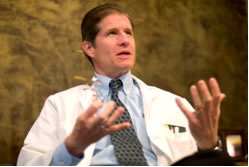
Dr. Lee Hood, M.D., Ph.D

Lee Hood, M.D., Ph.D

Dr. Lee Hood, infamous for his work in the creation of the equipment used by our present day scientists, launched a school of thought that has been generally accepted in the scientific community, Systems Biology. Dr. Wayne Jonas has pursued with passion his work in Systems Wellness. Both of these edge-running thinkers are also working to contribute to a medical degree at a leading university that will be entitled Systems Medicine.

The uniqueness of this type of thinking is not the newness of it. It is, in fact, a melding of the old and the new, the oldest and the newest approaches to healing. What Drs. Hood and Jonas separately yet collectively are advocating is an approach to illness that embraces the complexities of genomics and proteomics and allows that knowledge to be firmly wrapped in a swaddling of information that, in many cases, has been with us since indigenous man walked the earth, an Optimal Healing Environment.

Wayne B. Jonas, M.D.

Wayne B. Jonas, M.D.

We have all been inundated by the mythical promise of cures from fraudulent presenters, and the result of those untested, unproven, and unfounded promises has created a culture of distrust, cynicism, and fear that thwarts the reemergence of those healing practices that represented not only viable alternatives, but, in many cases, the only alternatives that were available to our societies less than eighty years ago. As we more clearly understand that the human body is a comprehensive system that interacts within itself on a myriad of levels, we also can begin to understand why individual responses to certain types of healing modalities also produce very different results, i.e., Systems Healing.

The philosophies, beliefs, and practices of the American Board of Integrative Holistic Medicine, a major group of practitioners who have come together to provide not only education, training, and additional resources to physicians in general, have also come together to ensure that those Systems Healing practices that were pushed aside for the promise of high tech and high chemistry are reintroduced to medicine and healing in an appropriate and informed manners. Their work is not new to mankind, to medicine, or to healing, but it is a reemergence of those long proven, highly embraced modalities that promote and support health and wellness, the new paradigm?

Share

Two Guys Medical Center

January 9th, 2009 by Nick Jacobs 13 comments »

Back in the early nineties, two of my peers replicated the pro forma and business plan of an offer made by a for profit hospital system that was interested in buying a specific medical center. They then presented it to a religious order and ended up buying a hospital which many of us began to refer to as “Two Guys Medical Center.” The difference was that, unlike the religious order, they were interested in it for some personal financial gain, the American way. Once the cash flow turned into a trickle, they found their way clear of ownership with heavy golden parachutes from the organization that bought the hospital, and it became the gift that kept on giving. All in all I’m sure that it was a very lucrative series of events that, after their or my death would make for a great fiction novel.

As I prepared for my departure from my previous employer, the entire issue of identifying someone to continue to carry the torch of leadership weighed heavily on my mind. Succession planning, if you will, was never far from my thoughts. With that in mind, I looked into the region and found, well, two guys. These two guys were very different from the previous two mentioned. They were committed to the good of mankind on so many levels that no one could question their personal intentions. Over a year later, the reality of their futures does not lie firmly in my hands when succession is discussed, but they certainly are two people to watch as the region’s health systems continue to morph medically.

Only four short years ago, Tom Kurtz, one of my two recruits, was working diligently every day in every way to ensure that four heart stents was an inadequate number for my chest. It had been his job at the competitor to literally master my strategic plan and to replicate it at an even higher level. He found federal, state, and local funds to begin a neuro-science center, research in post polio syndrome, work in anesthesia that would be converted to the battlefield, and, in his spare time to build and promote a Tech Park for the City of Johnstown.

We were usually friendly, but fierce competitors. He honestly has never told me the entire story of his journey with his former employer’s leadership, but I’m sure it would fill about ten of these blog posts. Tom was a master at political nuance and learned quite a bit about grants from the Department of Defense. He not only knew where to find them, he learned how to get the monies delivered to the projects for which he was responsible. Tom is progressive, aggressive, and knowledgeable about both the need to find sustainability on the research side and growth on the hospital side. When it comes to the “vision thing,” Tom embraced that as well. He’s not one of those cant-see-the-forest-for-the-trees guys. In fact, he is just the opposite of that. He sees the big picture and quickly embraces just exactly how things can be in the future with a little guts and a lot of persistence.

Dr. Matt Masiello

Then came Matt. Dr. Matt Masiello has been a friend for over a decade. He represents almost everything that I embrace philosophically. Matt is a gentle and kind man who fully comprehends the value of treating human beings like human beings. A background as a pediatrician has enabled him to understand compassion, and after having been in charge of intensive care for years, he has also learned of the heartbreak that this profession can bring. Dr. Matt captured my attention a year or so ago when, like me, he got involved with the World Health Organization. This time, however, he went way beyond my wildest dreams and has literally been appointed the U.S. representative for the WHO.

When my short history on this planet is finally written, let it be said that Matt and Tom have had a tremendous impact on our community, our region, and now our world as special attention is given to breast cancer research, and as health and wellness, prevention and anti-bullying programs are nurtured, cultivated, and grown by these two men. No, it’s not “Two Guys Medical Center,” but it sure is a medical center that has been positively impacted by two guys. Keep up the good work, Matt and Tom. This region needs you.

Share

Out With the Old, and In With the New

January 1st, 2009 by Nick Jacobs 1 comment »

It’s 5:33 PM on New Year’s Eve.  For some reason New Year’s Eve has become a significant contributor to some landmark memories for me, memories that will always be with me.  Maybe it’s because the day represents such finality.  Starting tomorrow, for example, 2009 better be the number that you write on the forms, checks, and documents because 2008 will be gone, gone, gone. 

One vivid and unique New Year’s Eve memory occurred back in 1985.  After making payroll 24 times a year for 59 consecutive months, success or failure all boiled down to the last day of December.  Truthfully, for the first time in five years, there was not enough cash to compete the payroll.  As I was closing down the office and preparing to leave for the night, the main door of the building opened and footsteps could be heard coming through the gallery.  My mind went immediately to the dark side.  Is someone coming here to rob or kill me?  Let’s be candid, this was a rural arts center, for goodness sake on New Year’s Eve.  Who in their right mind would be coming into the gallery five minutes before closing? 

As it turned out, the footsteps were coming from a donor who was there to present me with a check.  That check came to exactly the amount of money needed to complete payroll.  My immediate response was that the universe had, once again, taken care of the problem, but later, the concept of almost not making payroll put me over the edge and sent me on a job search for something that was just a little more secure. 

For two years after my father died, pneumonia became my New Year’s Eve visitor.  My kids were two years old and five months old, and my chest cold had gotten worse and worse until finally, the doc said, “It’s pneumonia.”  So, 1975 and 1976 were my pneumonia years.  The most memorable part of those two years was that pneumonia boy got to stay at home with the kids while the rest of the world partied.

Finally, the New Year’s Eve of Y2K holds a prominent spot in my brain as well.  The team of IT specialists, finance personnel, maintenance, and administrative leaders all gathered in the conference room to ensure that the the world would not come to an end.  Some of you have read the story before, but just as the ball began to drop on Times Square, one of our computer jocks accidentally leaned up against the light switch and all of the lights went off simultaneously.  A wave of palpable fear swept through the room until one of the team members said, “Hey, the television isn’t off; we’re okay.”

Well, today was my last day of work as a hospital administrator and research institute executive, but the puropse of this New Year’s Eve blog is not to tell you about my pneumonia, about light switches going off, or even about making payroll.  It is to let you know that, in spite of the title and career change, we’re doing okay.  So, Happy New Year to all, and remember, the only bad New Year is no New Year.

Share

Dr. Atkins and Me…

December 23rd, 2008 by Nick Jacobs 8 comments »

Some of you know my history . . . for a decade I was a totally dedicated follower of the Dr. Dean Ornish coronary artery disease reversal program.

For example, for the past ten years, the only thing that would typically pass between my lips at a holiday party would be party garnishes. No kidding; decorations, twigs, sticks… and the occasional veggie. No dips, no chocolates, no meats or shell fish, no cookies, no pie, no fat.

One interesting factor that evolved from embracing that philosophy is that, in spite of all of my efforts to enlongate my life, my personal challenges never really decreased. It hit me one day when I was looking in the mirror that I was actually peering at the enemy, and it was me. It has been pointed out to me that, for all intents and purposes, I am a crisis magnet.

During those years of complete passion for the Ornish program, there were many days where my adrenaline flowed freely. It usually happened when Dr. Ornish and Dr. Atkins had debates on television about their very different diets. Truthfully, the diet was such a small part of the Ornish program that it angered me when so much emphasis was placed on the complete disparity between these two very different programs.

Well, tonight I felt closer to Dr. Atkins than I had ever felt. In 1976, my buddy Jim and I went on the Atkins diet and lost about 30 pounds. That diet ended because the pork rinds, hard boiled eggs, and thousands of chicken wings, rashers of bacon, sides of beef, and pounds of cheese just became too much for me, and they probably resulted in my needing the Ornish diet.

What made me feel close to Dr. Atkins this time? Ice. He had slipped and fallen on the ice, hit his head, and eventually died from the injury. Well, tonight provided me with a bonding opportunity with Dr. A. It was the beginning of the holiday season. The kids had gathered for dinner with the four and a half grandkids, the soon to be deployed son-in-law, Moosie the dog, and Kiki the cat. It was a nice gathering and, as I walked off the porch and onto the walk, my feet went out from under me, my body went air borne, and I fell directly on my back with the force of a meteor hitting a dry lake. The wind left my body. Stars were flying around my head like a Road Runner cartoon, and pain began sweeping through my limbs in waves.

The difference between Dr. Atkins and me was that my head did not hit the ground. Was it a conscious decision to hold it up, or was it just pure luck? Don’t know, but, at least for now, it seems like I might live. The last time this happened to me was on a cold winter afternoon in 1978. After teaching for eight hours, I was leaving school with a baritone saxophone case in one hand and a euphonium case in the other, both destined to go to the repair shop. It was then that my feet left the ground. Once again, the air completely evacuated my lungs. It was that very day that I vowed to always wear rubber-soled shoes in the winter. Didn’t help tonight. Oh, well, at least my fall didn’t include a head injury. Dr. Atkins and I both needed more salt in our diets.

No fear. I’m still here.

Share

What Am I Up To?

December 19th, 2008 by Nick Jacobs 4 comments »

For those of you who might have any interest in this topic, read on . . . for the rest of you, have a great holiday. 

With seven working days remaining until the name of this blog should be officially changed to Ask a Former Hospital President.com, I’d like to just make a short list of the areas in which I have been and will be working as the International Director for SunStone Consulting.

1.  Patient Centered Care. . . It is clear that this area of expertise will be my first and foremost focus, my passion.  How can any hospital succeed in this arena?  How do you become not only patient but also employee centered in such a significant way that your HCAHPS scores improve, your infection rates will go down, your length of stay will decrease, and the bottom line will improve significantly?  That’s the story that is burning inside me.  So far my new job has included significant keynote speeches, visits to hospitals seeking this guidance, and plenty of blogs and articles.  With organizations like Planetree, the Samueli Institute, and American Healthcare Solutions seeking to spread this word, this topic should consume a great portion of my time.

2.  Patient Advocacy. . . When the day is done, and my time is over, it is my very deep desire to have helped to change healthcare significantly, and patient advocacy is a very clear key to the success of this goal.  My book “Taking the Hell Out of Healthcare” was the first step toward telling the advocacy story. 

3.  Being Green . . . No matter what the pundits say, the world will only become a better place if we all work toward a common goal, to reduce the carbon footprint.  The investments made in this arena will result in a multi-fold financial and philosophical payback to any organization seeking to explore a green philosophy.  We have agreed to do Beta work in this area, and believe that every hospital will benefit financially from this initiative.  Pittsburgh Gateways is leading this initiative, and it is my commitment to work with them to bring to my CEO peers not only the how to but also the financial benefits that will make this work possible.

4.  Being Digital. . . As my current position comes to a close, we can openly declare that we will be completely digital before the end of the fiscal year.  One of our tasks has been to bring groups of hospitals together through fiber connections for work on tele-mental health, tele-pharmacy, and disaster recovery.  These are only three of the myriad of initiatives that fiber connectivity will permit.  Corathers Consulting will be working with me to help introduce various aspects of this somewhat complex initiative to hospitals throughout the United States.

From these four areas of expertise, dozens of additional projects, services, and opportunities will also be made available like arrows in a quiver.  We will continue to promote our knowledge regarding the use of genomics in the hospital setting.  We are also working with groups to introduce other services through our peers and partners that will help hospital CEO’s in their journey to fortify and grow their organizations.  Areas such as strategic facilities plans, construction and finance alternatives, physician strategic plans, physician office work, legal partnerships, food purveyors, insurance services, benefits management, case management, fund raising, marketing, as well as literally dozens of other growth and infrastructure opportunities will be on this menu.

SunStone is also working with me on the most important aspect of these initiatives and that is to help hospitals, practices, and senior leaders find the money to initiate every aspect of the programs needed to thrive.  Be it DRG Transfers, Workmen’s Comp initiatives, RAC preparation, and a myriad of other financial initiatives that will result in finding or reclaiming money, SunStone has that expertise to bring to these initiatives as well.   

So, as Bob Hope said so many times, “Thanks for the Memories,” and thanks to everyone who has helped me through this very emotional transition.  Please don’t forget to “Ask A Hospital President.com” after the new year begins because being busy is my goal and helping you is my passion.

Share

More on Leadership…

December 12th, 2008 by Nick Jacobs 3 comments »

Nick Jacobs, FACHE author of Taking the Hell Out of Healthcare

One imperative for any leader is a positive mental attitude. We must work tirelessly on believing in ourselves, and then we must work constantly to reinforce that belief with positive self-talk. If we embrace that concept that we can, there’s a very good chance that we indeed can. If, on the other hand, we believe that we won’t, we probably won’t. This single belief can initiate all forward movement. Winners in life constantly encourage themselves to think that I can, I will, and I am, and they don’t focus on the past —the should have, would have, or can’t do’s are gone forever. We can never make a better past for ourselves.

Last year, one of our employees attended a non-traditional educational seminar whose primary focus was directed toward the analysis of different personality types. When the employee returned, I asked, “What did you learn?” Their response was, “I learned that the primary function of people with my personality type is to pee on your cornflakes, to rain on your parade, and to frustrate your every creative idea, because that’s just what we do.”

Hence the opening paragraph of this piece. We are in difficult economic times, and the general counsel from our advisors is more often going to be to take no risks. If they are doing their jobs, we will be inundated with reasons why we should be against almost everything. In fact, words like growth, expansion, and opportunity all seem to be put away as this storm cellar mentality prevails. They will argue that they are saving their organizations by “shrinking to greatness” while opportunity after opportunity slips away.

One of my favorite visuals of this mind set comes from the 1990 movie Ghost where the people were helped to find their place in eternity by little demons that came out of the sewer grates to drag their souls into Hell. As leaders, we are surrounded every day by people who see their job as one of hard, cold, black and white facts. There are the extremists who spend their days spreading pessimism, fear, gloom, and negative energy; looking at the down side as they constantly undermine not only growth, but the attitudes that foster growth. The blacker the sky, the deeper the reinforcement of their concerns, and the more intense the corporate paralysis becomes throughout the organization.

Positive Mental Attitude Psychologist, Denis Waitley helped to change my life when he lectured on this topic nearly 30 years ago. He had been the U.S. Olympic athletes’ psychologist. Dr. Waitley taught us to learn from the past, set vivid, detailed goals for the future, and live in the only moment of time over which you have any control: now. He always spoke about the reality that life is inherently risky and that there is only one big risk you should avoid at all costs, and that is the risk of doing nothing.

Don’t get me wrong, conservative thinkers are important in the balancing act of leadership, but they must never be given the power to control all aspects of an organization. It is a recipe for disaster. The result will be stagnancy and eventually, business failure. There must be a means to carefully look at what they have to say, to evaluate the risks outlined, and then to make a decision based upon the prudent person process, but, having said that, remember that leadership is not a gutless proposition.

If you are not interested in some sleepless nights, tension filled meetings, or numerous failures, don’t get into the game. As Waitley says, the winner’s edge is not in a gifted birth, a high IQ, or in talent. The winner’s edge is all in the attitude, not aptitude. Attitude is the criterion for success. There are two primary choices in life: to accept conditions as they exist, or accept the responsibility for changing them.

A leader’s world is not always black and white.

Share

Last Board Meeting…Next Challenge

December 4th, 2008 by Nick Jacobs 40 comments »

After nearly a dozen years, I attended my last board meeting as President/CEO of this hospital yesterday. I believe that I have missed only one meeting in all of those years. As I retire from the day to day operational aspects of health care and move into the next chapter of my life, it seems like a good time for reflection.

Looking back at the previous twenty plus years, my heart is filled with wonderful memories and the support of many friends, and it is also filled with the challenges and hurts that are almost always a part of senior leadership. A mentor once told me that, “The wind blows hard at the top of the pole.” I’ll never forget another suggestion that came to me from one of my former bosses when I informed him that I was thinking about becoming a hospital president. He said, “If you think you want to run a hospital, make sure you go somewhere where it is the only game in town, in the county, and preferably in the region.” Well, obviously, that was one more piece of advice that went by the wayside. We landed in a place where there were four hospitals all using the same media.

Having started as a musician and band and orchestra director, I have never moved very far from my education roots. It has always been about open communications, respect, dignity, encouragement, a spirit of co-operation, and positive mental attitude for me and those around me. In many ways, being a dad and a teacher was the best practice anyone could have had for running a hospital. Even though one of my favorite sayings was “I don’t want to be anyone’s parent here,” it seemed that there were numerous situations that were similar to the same types of issues that were regularly part of any family’s interactions.

Health care, however, is changing rather dramatically. As our economy and the Boomers both begin to shake, health care has to seek its own level. Will it be directed more toward wellness and prevention? Will it be rationed? (Rationing, of course, would indicated that everyone would get some of what is being offered. You know, similar to sugar rationing in World War II. They just wouldn’t get as much. The reality of our current system is that some get everything and others get NOTHING. Consequently, rationing may not be a great description of this process.)

My new charge is to help hospitals find their niche’, to help them find money and most importantly to find stability by becoming patient centered. We will be attempting to provide hospitals with the knowledge gained from over twenty years of experimentation into areas that had not been popular before we explored them. We will be helping hospitals to become patient-centered, digital, and green to name a few.

Some day, all of this will make sense to those of you who doubt. It was interesting when my career path went from teaching, to arts management, to tourism, to health care. The skeptics deeply questioned the transitions, but it all made sense. As I went from one discipline to the next, it all merged together in a meaningful way in health care management.

Now, we are launching into one more area of expertise, but this time, we have 40 years of experience, and deep knowledge regarding not only life, but marketing, communications, Web 2.0, patient centered care, construction, carbon credits, ambiance, Planetree, Optimal Healing Environments, employee centered care, recruitment, data mining, proteomic and genomic research, wellness centers, hospice, behaviorial modification, food services, fund raising, integrative medicine, and digital radiology equipment. So, if anyone needs a motivational speaker, some advice on OC48 lines, 3TMRI breast coils, micro turbines, public relations campaigns, or anything from the list above, remember me. My web address contact information will be nickjacobs@sunstoneconsulting.com.

Share

Engage With Grace

November 27th, 2008 by Nick Jacobs 6 comments »
The One Slide

The One Slide

Several dozen bloggers in the health care field and beyond are today engaged in a blog rally*, simultaneously posting the item below to encourage conversation about a topic that’s often avoided but needs to be addressed in every family: How we want to die. I’ve written about this before, with regard to my mother. Please try it, using the slide above as a discussion guide. It’s not that hard to have the conversation with your loved ones once you get started.

We make choices throughout our lives – where we want to live, what types of activities will fill our days, with whom we spend our time. These choices are often a balance between our desires and our means, but at the end of the day, they are decisions made with intent. But when it comes to how we want to be treated at the end our lives, often we don’t express our intent or tell our loved ones about it.

This has real consequences. 73% of Americans would prefer to die at home, but up to 50% die in hospital. More than 80% of Californians say their loved ones “know exactly” or have a “good idea” of what their wishes would be if they were in a persistent coma, but only 50% say they’ve talked to them about their preferences.

But our end of life experiences are about a lot more than statistics. They’re about all of us. So the first thing we need to do is start talking.

Engage With Grace: The One Slide Project was designed with one simple goal: to help get the conversation about end of life experience started. The idea is simple: Create a tool to help get people talking. One Slide, with just five questions on it. Five questions designed to help get us talking with each other, with our loved ones, about our preferences. And we’re asking people to share this One Slide – wherever and whenever they can…at a presentation, at dinner, at their book club. Just One Slide, just five questions.

Lets start a global discussion that, until now, most of us haven’t had.

Here is what we are asking you: Download The One Slide (that’s it above) and share it at any opportunity – with colleagues, family, friends. Think of the slide as currency and donate just two minutes whenever you can. Commit to being able to answer these five questions about end of life experience for yourself, and for your loved ones. Then commit to helping others do the same. Get this conversation started.

Let’s start a viral movement driven by the change we as individuals can effect…and the incredibly positive impact we could have collectively. Help ensure that all of us – and the people we care for – can end our lives in the same purposeful way we live them.

Just One Slide, just one goal. Think of the enormous difference we can make together.

(To learn more please go to www.engagewithgrace.org. This post was written by Alexandra Drane and the Engage With Grace team. )

Share