Archive for the ‘Healthcare’ category

HIMSS

April 15th, 2009

HIMSS, Healthcare, IT, health, information technology

If you’re interested in finding about everything that happened at the HIMSS 2009 Conference and Expo, don’t read on, because I’m just going to focus on four or five companies that captured my imagination there. There were hundreds and hundreds of vendors attempting to do business in the massive McCormick Convention Center in Chicago, and most of the participants were clearly interested in attracting some bailout money. My host for the week-end was Apptis, and a special thanks must go out to them for allowing me to grace their exhibit as an observer.

Genova Technologies
The companies that grabbed my attention were rather unique; neither the largest, nor the most aggressive. Not the end all and be all of IT, but niche players that had their acts together. Dawn Ainger, the President and COO of Genova Technologies was the first to garner my complete attention. She and her people had come up with a software platform that is uniquely positioned to change the entire concept of Continuing Medical Education. Just log onto their product for somewhere around $100 a month, and voila, everytime you research a patient’s ailment online you get CME credits backed by a major university. Next, she plans to expand to nursing education as well. My oh my, will that change plenty of lives? Our typical employed physician used to get an automatic $4,000 a year stipend for CME in our little rural hospital and never got credit for the work they were already doing. Nice job, Dawn.

logo_aclaim
Not that all of the products that captured my attention were produced by companies run by women, but a-claim was, and their President and CEO Mary Dees Griffith had come up with a similarly low cost solution to a major, ongoing problem. Get your a-claim software, and prequalify your patients on line, have them sign the authorization prior to being seen, and then ask them for their check or credit card for the co-pay that you now know will be approved. Nice job, Mary. Every physician’s office in the world should spend $100 or so a month for that one, because it could virtually eliminate their accounts receivables.

logo_lifelinks
As I was walking by Lifelinks, I noticed a butterfly logo and was curious as to what they did. Once again, their basic, get-you-in-the-door fee was about $100 a month, and that will get you access to live human beings on your lap top who can perform sign language interactively with your patients, or, if need be, Lifelinks will get you live and online someone who speaks whatever language your patient needs. Okay, so that’s probably not a big problem in a small town in Western Pennsylvania, but I’m sure it’s perfect for those offices in highly diverse regions of our country. More importantly, their literature pointed out a case in New Jersey where a physician had been sued and the patient won $400,000 because the doc told her he couldn’t afford a translator. Good job, guys. Wesley Waite, the COO, actually hit the keyboard, and a woman came up on the screen to interact with me personally in sign language. Amazing.

Gemalto, health, security, Netherlands
Gemalto,
a Dutch based company really grabbed my attention in the world of cyber security on a small, simple scale. Well, okay, not so small I guess. They have over 100 million of their devices already in use in the EU, but not too many in the US yet. The Gemalto team took us happily through the safety and security they can build into their smart cards to keep you from being hit with a major civil and/or criminal penalty for compromised information.

voalte_iphoneThe wildest display tucked in the back corner of one of the exhibit halls was a lime green and pink booth with the word, voalté across the top of their exhibit. A really nice guy named Oscar in pink scrubs and a black voalté teeshirt was my tour guide through I-phone heaven for nurses, techs, and other hospital professionals. What they have created with this system can only be described as remarkable. It shimmies, it shakes, it crawls on its belly like a reptile. Seriously, paging, messaging, dosing, you name it can all be communicated to your staff via the Apple iphone. No more overhead pages, no more, “I didn’t get that message,” no more I’m busy because if you are, that page keeps being passed along until someone isn’t busy. This Sarasota company is fresh, fun, exciting, and competent.

So that’s my little trip down HIMSS lane. Oh yeah and I got to have lunch with the brilliant Tony Chen of both HospitalImpact.org and SavvyDaddy.com fame. I encouraged Tony to follow his dreams, and he told me today in an E-mail that he is going to do just that. You go, Tony. And Neil Versel, the very talented free lance writer, journalist, and U2 fan nearly knocked me over at the entrance. I met Neil a few years back at a Web 2.0 conference in Chicago, and there were at least two or three other people there I had worked with over my 22 years in Healthcare Management. The biggest outcome?

My feet are still killing me.

Share

Healing and the Mind Revisited

April 8th, 2009

I’m working in Chicago right now, feeling a little overwhelmed by a phone call that I had from one of my very dearest friends about his impending future, about my son-in-law in Baghdad and his family who are living without him at home, and also about the challenges that we individually and collectively face both nationally and internationally during this time of economic crisis and overall unrest. During the midst of my thoughtful contemplation, I received an E-mail from a very dear friend, Savery, with a link to open. I was so moved by it that I decided to post the link on Facebook.

Almost immediately after it went out, my friend, Dr. Dean Ornish, sent me this follow up link from Bill Moyer’s show. For those of you who don’t know this about me, the Bill Moyers series, “Healing and the Mind” was my inspiration for the Planetree Philosophy that we implemented at Windber all those years ago. For some reason, he and I keep intersecting, and here we are again.

So, thanks, Savery, Dean, and Bill, but most of all, thanks to the amazing man who created this wonderful experience that you are all about to have.

Share

NickJacobs.org???

April 2nd, 2009

Let me open this blog with a little housekeeping chore. Because I’ve retired from being a hospital president (Yes, they replaced me with two great people, count ’em, two.) , I’d like to change the name of this thing. It’s not that I’ve established a P-Diddy-type Twitter following where 100,000 human beings are waiting with baited breath to see what my next move will be, it just doesn’t seem right to keep calling myself a hospital president. We know who reads this thing, and we are grateful to our loyal, talented, and brilliant followers. We also know that we can link the old blog names to get you here. So, regardless of what you typed, or what gets Googled, our genius social media maven & webmaster, Michael Russell, can help to bring you home to this site.

Okay, so as a transformational advisor, a broker of sorts, most people with whom we have consulted have described me as a person who can fix things that are broken before they actually break. Maybe we should call it the “Break it if it’s not already fixed” blog. I’d love it if it was a name that would generate millions of hits and companies would fight to advertise on it.

My first thought was to use nickjacobs in the title because there is a Nick Jacobs on Facebook who teaches Aboriginal people in Australia, and he seems popular. There is another Nick Jacobs who is a professional organist, and one who is an athlete. There’s a Nick Jacobs who is a consultant and another a paramedic in London, one who had a blog who is a yachtsman, there’s my son, the commercial real estate broker, and finally, there’s a Nick Jacobs who does pornographic movies who is not my son. Actually, that Nick Jacobs’ followers would probably be the most disappointed by this blog.

Since the .com version of nick jacobs was already taken by some guy in England, we captured nickjacobs.org, and that will work for right now.

If you have any ideas, however, that you think would really rock the blogspere, let us know and we’ll check with our domain registrar to see if it is available. In fact, if you are the winner of a Name Nick’s Blog Contest, I’d be happy to consult for free BY PHONE for at least one hour of brainstorming with you about the topic of your choice: music, healthcare, proteomics, teaching, PR/Marketing, the travel business, or even physician recruitment.

Remember, Hospital Impact is already taken, and, because my last three consulting jobs have been with a newspaper, a nonprofit arts oragnization, and a chain of hotels, we don’t want to think too restrictively. Gotta earn a little money, too.

When we ran the breast center, we found that the website got more hits than anyone could imagine. The problem was that the readers were mostly thirteen-year-old boys who probably weren’t too interested in running a hospital. After Miss America had visited us, the hits went up exponentially when those two searches were combined. Somehow, I don’t think that Nick Jacobs’ Breast Center for Miss America would probably get me the type of following I’m currently hoping to attract. On the other hand?

A very good friend recently asked me to write a brief bio about what my new life is like, and it struck me that it is very much like my old life but without any restrictions. This is what I wrote:

While teaching junior high school instrumental music in the early 1970’s, Nick Jacobs made an extraordinary discovery. He learned that, by empowering his students and surrounding them with positive influences, he no longer was providing a service or even an experience for them.

What this entirely unique teaching style resulted in was a method for helping to transform students. By providing with both passion and commitment the tools needed by them to undertake their journey, his involvement with the students became a means of dramatically helping them to make whatever positive life changes they were seeking.

It was during that early period in his career that he also discovered that this formula could work to positively change lives in almost any aspect of living as he ran an arts organization, a convention bureau, and finally a hospital and research institute.

Since that time he has dedicated his personal work to helping others make their lives better, and that is exactly what he is doing in his position as an international executive consultant with SunStone Consulting, LLC.

Maybe that will give you something to chew on? Okay, something on which to chew.

SunStone Consulting. With more than 20 years experience in executive hospital leadership, Nick has an acknowledged reputation for innovation and patient-centered care approaches to health and healing.

Share

TED and “me?”

March 20th, 2009

Okay, I’ll admit it. I’ve been obsessing over TED. If you aren’t sure what TED stands for, it is an abbreviation for (Technology, Entertainment, Design) and TED is an invitation-only event where the world’s leading thinkers and doers gather to find inspiration. It’s in California, of course.

While spending an absolutely delightful weekend a few months ago with several people who were creative, inventive, entrepreneurial, and fun, one of the most highly respected innovators in the world turned to me and said, “You should be on the agenda at TED.” You may wonder what qualifies one to be considered to be one of the most highly respected innovators in the world, but take my word for it, he is. He’s on the faculty of about eight universities, has offices in a couple of dozen countries, and is one of the most sought after creators of innovation anywhere.

Well, little did he know how much that comment meant to me. It shook me up, inspired me, and filled me with excitement. Why? Read that line above again, “an invitation-only event where the world’s leading thinkers and doers gather to find inspiration.” Okay, I’ve been called a futurist, a creative, a right-brained whatever, and several of the things that we’ve done over the years have literally rocked the house (like this blog), but . . . in the world? It always seemed to me that my primary claim to fame was my ability to keep trying when some people not only wanted us to fail, but would probably have like to have seen me personally run over by a cement truck. I was persistent.

I’m not sure where I would fall into that description of the world’s leading anything, but it surely was flattering to have someone of that caliber say that to me. It’s funny, because every time I begin to allow the little ghosts come out of the sewers to pull at my pants cuffs with their negativity, I simply smile and think about our collective accomplishments.

This week alone, our consulting practice has taken me to a publishing company to help their employees begin to create what they would like to have for their future; then to a chain of hotels in New York City where the owner fully comprehends the merits of wellness for his employees; to a biomedical informatics startup company specializing in neuroscience; a nonprofit music group struggling to re-invent itself; and finally to an executive recruitment firm seeking a new business niche.

So, back to TED. If you have ANY interest at all in what goes on there, what gets said there, who speaks there, you probably would be surprised, or not. People like Dr. Dean Ornish, Bono, Bill Gates, Jane Goodal, and former President Bill Clinton have spoken there, but so too has Dr. Alan Russell from the University of Pittsburgh and a hundred other people who have simply made a difference –with extraordinary results. The good news is that, should you have any interest in seeing and hearing any of these speakers, just go to TED Talks on the web, and they’re all there for your inspiration.

For example, in a presentation by Scott McCloud, the cartoonist and comic book artist, we heard: “Learn from everyone. Follow no one. Watch for patterns. And “Work like hell.” Stefen Sagmeister has made his mark by creating public art with sayings displayed in public places like, “Everybody thinks they’re right,” and “Money does not make me happy.” My favorite, however, is “Complaining is silly. Either act or forget it.”

Jill Tarter, astronomer and a world-renowned expert on extraterrestrial life made this comment, “If we are alone, it is an awful waste of space.”

Seriously, take a look at TED and its companion, TEDMED, dedicated exclusively to healthcare innovation. Maybe, in my dreams, I’ll be giving my speech on kindness in the workplace, my 18 minute presentation on life, love, and a kinder more co-operative future.

Hey, we all need a dream. And I, too, have a dream.

Share

The Not-So-Merry-Go-Round

March 7th, 2009

Dr. Wayne Jonas, President and CEO of the Samueli Institute, a friend and mentor, testified before the U.S. Senate on February 23, 2009 regarding his views for creating a path to health care reform. Dr. Jonas, a well respected member of the Washington D.C. health community formerly served as the Director of the Medical Research Fellowship at the Walter Reed Army Institute of Research (WRAIR), a Director of a World Health Organization Collaborating Center of Traditional Medicine and a member of the White House Commission on Complementary and Alternative Medicine Policy.

Wayne B. Jonas, M.D.

Wayne B. Jonas, M.D.

It is not my intent to copy this testimony, but only to accentuate some of the salient points contained within his work. Let’s begin by looking at some chilling facts. By 2082, healthcare expenditures will represent 49% of our Gross National Product. This is due to the fact that in 2011, the baby boomers will begin to turn 65 when, in the words of Dr. Jonas, “an avalanche of aging care needs…will bury the current Medicare system.”

Obviously, this is a case where more of the same is not necessarily better and, unless or until the system changes, and we fashion a new vision to create health, we will bankrupt our country. Dr. Jonas then went into the facts and figures that those of us in health care who believe in wellness, integrative medicine, and a holistic approach to healing have known for years. Seventy percent of chronic illness is due primarily to lifestyle and environmental issues, including proper substance use (smoking, alcohol, drugs, diet, and environmental chemicals), adequate exercise and sleep, stress and resilience management, social integration and support, and selective disease screening and immunization.

We are on a not-so-merry-go-round, which has an entire system of illness incentives that are improperly reimbursed, improperly addressed, and inappropriately segmented as if each part of our body was not a component of the whole. It is time to begin to throw the switch and to teach our patients what we already know so that wellness, wholeness, and health can be given a new definition.

Dr. Jonas specializes in Systems Wellness. Dr. Leroy Hood specializes in Systems Biology. We as a country need to demand that our medical schools embrace both concepts as, like indigenous man, we begin to realize that our brains do have something to do with our bodies, as we realize that our commodity driven society does not always promote the BEST food, the BEST exercise, the BEST of anything but, instead, because of the quarterly reports to the stock holders, promotes the most lucrative.

We know that drinking a soft drink with 10 teaspoons of sugar is not exactly healthful. We clearly understand that quadruple cheese anything might eventually catch up with us, or that Uncle Buck’s 72 oz. steak can’t really be good for your arteries. Fried and buttered everything, a total lack of exercise, and more stress than anyone can ever dream of will not extend our lives. There is a reason why most of our physicians die ten years before their patients. Between the battles to get their degrees, the incredibly long hours, the pressure of dealing in life and death issues, and the demands of dealing with a broken healthcare system, they need stress management as much as anyone.

How much further down must we go as a country before we begin to realize that millions of dollars, dozens of expensive toys, mansions, and rich food are not true measurements of success? During a visit to the Netherlands a few years ago, I told my host that I would be back in August. She looked at me, smiled, and said, “Don’t bother. The entire country will be on vacation,” and they were. Many European countries take 52 paid days off per year. Sure, their cars are smaller or they use bikes and generally they may own less clothing, but they are living longer, healthier lives.

Share

The Marketing Enigma

February 15th, 2009

As the economy continues to present its myriad of challenges nationwide, hospital executives are embracing a variety of cost-cutting measures at a very high rate of implementation. Delays or discontinuation of capital projects, employee layoffs, and a variety of other broad-based measures are currently dominating the healthcare environment.

Departments without direct patient contact are usually perceived to be the easier layers to peel in these expense reduction activities. Areas such as marketing, community, and public relations often become prime targets as they are significantly scaled back or even disbanded.

Historically, hospitals have implemented fluctuating sequences from one extreme to another as they have decreased and increased marketing department sizes and budgets through the various economic cycles. Unmistakably, in challenging economic times, marketing is nearly always more important than ever. Without knowledge concerning the various services available, the patients will not be aware of the nuances of each and how they could impact their health and wellness.

Having said this, however, many hospital executives are not experts in this area, and consequently, they simply move in lockstep with those individuals who see these programs as non-patient expense centers that merely drain the organization of its valuable resources even further.

BusinessDictionary.com aptly describes marketing as the management process through which goods and services move from concept to customer. As a philosophy, it is based on thinking about the business in terms of the customer, or in healthcare, patient needs and their satisfaction. As a practice, it consists of the coordination of four elements:

  • identification, selection, and development of a product
  • determination of its cost
  • selection of a distribution channel to reach the patient, and…
  • development and implementation of a promotional strategy designed to reach these goals

In order to avoid erroneous decisions that could lead to disastrous business consequences for the organization, marketing evaluations might be performed by professional marketing assessment companies specializing in this arena. Some of these firms can provide this service in economically viable risk-reward agreements that do not further complicate the financial challenges being addressed. They specialize in the evaluation of services that detail which marketing functions need to be continued and which functions should be restructured, and/or outsourced. The goal of these marketing evaluation firms is to:

  • help preserve the existing positive effects created by marketing
  • build better marketing practices, and…
  • cut the unnecessary associated costs

In two decades of observing the yo-yo phenomena described above, we have worked with numerous individuals and firms along the way, but none have been more valuable than the firms that specialize specifically in this area of marketing department analysis.

Firms that provide this specific service can be found through the American Association of Healthcare Consultants, The American Marketing Association, and the Society for Professional Marketing Services.

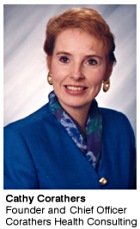
In our work, however, we have found at least one company that has continuously provided the necessary analytic and evaluation components required to complete this sensitive task. Corathers Health Consulting is a unique organization because it utilizes luminaries and unique specialty consultants through a team approach for most of their highly customized projects. What we observed when we worked with Corathers was that their distinguished consultation supplied an unparalleled differentiating factor over the other consulting companies with whom we had previously worked, but they are one of many such firms.

Regardless of the organization chosen, the concept is the key, and that is that you owe it to yourself and to your organization to understand exactly what can or should be eliminated or outsourced before the cuts are irreversibly implemented. The future of your organization may lie directly under that hatchet, and once the decision has been made, reverse is a costly gear to find on a very bumpy road of lost business, missing publicity, and absent advertising. The answer lies in cutting wisely and appropriately as you attempt to keep patients informed and to grow your business.

Linking a patient-Centered Approach to Quality Improvement & HCAPS

Nick Jacobs, FACHE addresses the 2008 Healthcare CEO Summit, co-sponsored by the Picker Institute and Planetree. Chicago, IL USA – Fall, 2008

Share

Like Deep Sea Fishing

February 2nd, 2009

Being a little older or just more chronologically mature makes this new life of consulting somewhat like snorkeling or even deep sea fishing for me. It’s a whole new world out there. If the total culmination of all of my experiences were listed on an 8½” x11″ sheet of paper in order of interest, category, and complexity, it would have to be written in 4 pt. type.

When it comes to prioritizing, cataloging, and quantifying my consulting practice desires, skills, knowledge base or just interests, this gets somewhat crazy at times.

For example: Planetree and the Samueli Institute have both captured my imagination and, I’m sure that over the years, I’ve captured theirs as well. Optimal Healing and Patient Centered Environments are my forte, my passion, and my love.

Do you know all about Web 2.0 …or 3.0, as some are calling it now? I’ve presented all over the United States and been featured on podcasts and webinars for years. How should you use Twitter, YouTube, and other streaming video platforms, Facebook, Blogs, Podcasts, Webinars, and other new technologies to move your business forward, to publicize your specialities, and to get your company’s name out there?

The actual science of microbiology is NOT necessarily one of my passions or deep skill sets, but running a research institute for nearly a dozen years that specialized in proteomics, genomics, biomedical informatics, and histopathology while interacting with the Department of Defense and Military medicine community certainly is a skill base developed through massive amounts of tears, sweat, and blood (my own). This information alone should be something that someone needs to know about on a regular basis.

The world of small and rural hospitals you say? My goodness, name someone who has had more “edgerunning” experience in this area than I have, and I’ll personally send them flowers. The growth, nurturing, care and feeding of a hospital that is smaller than 100 beds takes special stamina and a very positive mental outlook, because limited resources require unlimited creativity.

Economic Development through technology, healthcare, small businesses, and even tourism seems to have been a recurring theme in my world for decades. Jobs, Jobs, Jobs.

How about OC-48 dark fiber, telemedicine, teleradiology, telepharmacy, telecritical care, and teledermatology? Been there, done most of that, and have been working with groups and contacts who can add electronic medical records, disaster recovery/business continuity, data fusion centers, and other areas of specialty to your needs.

Interested in being an all-GE shop? Going completely digital? Having a 3T MRI with a breast coil? How about mobile PET/CT or the latest in mammography, and data repository technology? Okay, I’m not an expert, but I sure do have some interesting knowledge and amazing contacts here, and when it comes to breast care centers, we constructed one of the finest in the world.

Green? Wanna be green? Well, unlike Kermit’s song, it can be easy being green, and one of my current assignments involves everything green for schools, churches, and, most importantly, hospitals. How to get there, how to save, and most importantly, how to MAKE money from going green is currently something that we understand.

The Dean Ornish Coronary Artery Disease Reversal Program that we established is one of the best in the country, and we know how to set them up, run them, and help them prosper.

What about the World Health Organization? Work in the Netherlands, Croatia, Bosnia, Serbia, Montenegro, England, Italy, Greece, and even Africa interests me deeply, and my contact lists from those areas are very long indeed.

Construction? How to afford it? Alternatives to traditional methodologies, traditional financing, and Planetree design? Yep, we have that knowledge base, too.

Of course, there are things that you probably haven’t even considered: Wellness or EQ education, Patient Centered Care models, employee centered care to get you to patient centered care, the use of Markeking to grow your organization and to protect your position, and don’t forget: board relations, strategic planning, employee education, and, of course, nutrition.

Now, add to that this list of skills that SunStone brings to our table as well: the CDM, charge process, Compliance, Documentation Accuracy, Inpatient Coding and Compliance, Outpatient Charge Process Analysis, Outpatient Billing Maintenance, Pharmacy Revenue Cycle, Pricing, Recovery Audit Contractor Readiness, Reimbursement and Financial Analysis, Revenue Cycle, Transfer DRG’s and Workers’ Compensation Recovery.

IF YOU NEED US… Remember:

F. Nicholas Jacobs, FACHE
International Director
SunStone Consulting, LLC
1411 Grandview Avenue,
Suite. 803
Pittsburgh, PA 15211
nickjacobs@sunstoneconsulting.com

Home Office: 412-381-3136
Mobile: 412-992-6197
Fax: 866-381-0219

Share

Never Look Back

January 21st, 2009

Never look back.

That should be the motto of every outgoing president. You did the best that you could. You did what you thought was right. You gave it your all, but when the power changes, when the new world order takes shape, and when you fly off to your new life, it will be forever evident that what you did will not be what your predecessor will do. It will not be what you fought for, believed in, or worked so hard to accomplish. So, never look back; George W., Bill, George, Jimmy or Nick. It was what it was; it is what it is, and you can’t change either the past or the future. You can only go on with your life.

With the changing of the guard this week in Washington D.C., the entire process was very moving to me. Things that are being proposed seem so obvious, so clear, so amazingly right, but they too will most probably be disassembled almost before the door is closed on our next president’s final helicopter ride. The only worst situation would be if all of President Obama’s former loyal leaders would stay behind and make those disassemble decisions on the next inauguration day.

In the raw emotion of abstract observation, it dawned on me that, my time as a president is over, too and that change will happen as it is permitted to happen by the leadership left behind. It also became clear to me that my role should now be one of elder statesman not that of interfering has been.

We built this city on rock ‘n roll” is a song that plays over and over in my head. In our case, we received international recognition because of the uniqueness of the institutional soul that evolved there. It was an open, progressive environment, but, more importantly, it was an environment filled with positive energy.

My role now as elder statesman is to offer advice only if asked, to realize that my time is indeed over as a president, and to help those who believe in what we once created to do the same for their organizations.

It is not to attempt to stop motion, no matter which direction it is flowing, but this part is damn hard, and I don’t have a library to focus on building.

Share

Make Sure That You are on the Right Side of the Paradigm Shift

January 15th, 2009

The word paradigm provides a cerebral representation of a model that, throughout our lives has remained relatively constant. Transformational changes in the manner in which we travel, how we communicate, and even in the ways that we are educated have simultaneously produced significant shifts in those models as well. In the early 90’s, we were informed that the information being transferred to us would only be viable and, in fact, would be very nearly invalid within about 18 months or so after ingestion.

Those parameters of informational decay continue to diminish exponentially as we immerse ourselves in 24-hour instant access to changing data, innovative discoveries, and altering states of acceptance of ideologies that were once believed to be infinite in their substance. Science is only valid until the next discovery.

The archetypical model of high-tech health care that was believed to be our “Star Trek” salvation from the ills of our parents, and their parents is currently being exposed as an artificial promise that has failed to deliver healing. Each decade our technologists have produced new; more sophisticated, and higher priced equipment with promises of earlier detection. Unfortunately cures have not been part of the equation. The additional technology has simply produced additional questions.

As we delve into the diva world of science, we find many reasons why significant progress has not been made, mostly related to a lack of continuity in the incentive systems. But, because of these failures to heal, we also may now be able to discern another reality that will truly contribute to the new world order of medicine.

Dr. Lee Hood, M.D., Ph.D

Lee Hood, M.D., Ph.D

Dr. Lee Hood, infamous for his work in the creation of the equipment used by our present day scientists, launched a school of thought that has been generally accepted in the scientific community, Systems Biology. Dr. Wayne Jonas has pursued with passion his work in Systems Wellness. Both of these edge-running thinkers are also working to contribute to a medical degree at a leading university that will be entitled Systems Medicine.

The uniqueness of this type of thinking is not the newness of it. It is, in fact, a melding of the old and the new, the oldest and the newest approaches to healing. What Drs. Hood and Jonas separately yet collectively are advocating is an approach to illness that embraces the complexities of genomics and proteomics and allows that knowledge to be firmly wrapped in a swaddling of information that, in many cases, has been with us since indigenous man walked the earth, an Optimal Healing Environment.

Wayne B. Jonas, M.D.

Wayne B. Jonas, M.D.

We have all been inundated by the mythical promise of cures from fraudulent presenters, and the result of those untested, unproven, and unfounded promises has created a culture of distrust, cynicism, and fear that thwarts the reemergence of those healing practices that represented not only viable alternatives, but, in many cases, the only alternatives that were available to our societies less than eighty years ago. As we more clearly understand that the human body is a comprehensive system that interacts within itself on a myriad of levels, we also can begin to understand why individual responses to certain types of healing modalities also produce very different results, i.e., Systems Healing.

The philosophies, beliefs, and practices of the American Board of Integrative Holistic Medicine, a major group of practitioners who have come together to provide not only education, training, and additional resources to physicians in general, have also come together to ensure that those Systems Healing practices that were pushed aside for the promise of high tech and high chemistry are reintroduced to medicine and healing in an appropriate and informed manners. Their work is not new to mankind, to medicine, or to healing, but it is a reemergence of those long proven, highly embraced modalities that promote and support health and wellness, the new paradigm?

Share

Dr. Atkins and Me…

December 23rd, 2008

Some of you know my history . . . for a decade I was a totally dedicated follower of the Dr. Dean Ornish coronary artery disease reversal program.

For example, for the past ten years, the only thing that would typically pass between my lips at a holiday party would be party garnishes. No kidding; decorations, twigs, sticks… and the occasional veggie. No dips, no chocolates, no meats or shell fish, no cookies, no pie, no fat.

One interesting factor that evolved from embracing that philosophy is that, in spite of all of my efforts to enlongate my life, my personal challenges never really decreased. It hit me one day when I was looking in the mirror that I was actually peering at the enemy, and it was me. It has been pointed out to me that, for all intents and purposes, I am a crisis magnet.

During those years of complete passion for the Ornish program, there were many days where my adrenaline flowed freely. It usually happened when Dr. Ornish and Dr. Atkins had debates on television about their very different diets. Truthfully, the diet was such a small part of the Ornish program that it angered me when so much emphasis was placed on the complete disparity between these two very different programs.

Well, tonight I felt closer to Dr. Atkins than I had ever felt. In 1976, my buddy Jim and I went on the Atkins diet and lost about 30 pounds. That diet ended because the pork rinds, hard boiled eggs, and thousands of chicken wings, rashers of bacon, sides of beef, and pounds of cheese just became too much for me, and they probably resulted in my needing the Ornish diet.

What made me feel close to Dr. Atkins this time? Ice. He had slipped and fallen on the ice, hit his head, and eventually died from the injury. Well, tonight provided me with a bonding opportunity with Dr. A. It was the beginning of the holiday season. The kids had gathered for dinner with the four and a half grandkids, the soon to be deployed son-in-law, Moosie the dog, and Kiki the cat. It was a nice gathering and, as I walked off the porch and onto the walk, my feet went out from under me, my body went air borne, and I fell directly on my back with the force of a meteor hitting a dry lake. The wind left my body. Stars were flying around my head like a Road Runner cartoon, and pain began sweeping through my limbs in waves.

The difference between Dr. Atkins and me was that my head did not hit the ground. Was it a conscious decision to hold it up, or was it just pure luck? Don’t know, but, at least for now, it seems like I might live. The last time this happened to me was on a cold winter afternoon in 1978. After teaching for eight hours, I was leaving school with a baritone saxophone case in one hand and a euphonium case in the other, both destined to go to the repair shop. It was then that my feet left the ground. Once again, the air completely evacuated my lungs. It was that very day that I vowed to always wear rubber-soled shoes in the winter. Didn’t help tonight. Oh, well, at least my fall didn’t include a head injury. Dr. Atkins and I both needed more salt in our diets.

No fear. I’m still here.

Share