Posts Tagged ‘Healthcare’

Carrots or Sticks?

January 30th, 2010

When you do the math, you can rather quickly determine that, as the aging process continues with the Boomer generation, federal funding for health care and Social Security will become more and more scarce. At the same time, we have all read the sobering national statistics regarding unnecessary deaths from hospital missteps. The CMS (Center for Medicare and Medicaid Services) previously introduced a form of pay for performance, or –more accurately– no pay for performance, which has already caused a great deal of change in the American Healthcare System.

As is widely known by now, CMS has decided to literally stop paying for the treatment costs of preventable medical complications.  This actually may seem like an intelligent idea. This approach is referred to by some as visibility for good care, and there is no doubt that it will represent the beginning of a stampede from the third-party insurance payers to follow the CMS “Big Dog.”  In fact, several companies have already announced that they will not be reimbursing hospitals for similar errors, as well.  The truth of the matter, however, is that this step does not even begin to address the problem.

The problem is not about penalizing hospitals, it’s about creating an incentive system that is not disease and sickness based.  Until the pyramid is flipped, we will not see the necessary changes to halt this financial slide to economic oblivion.

Sanjay Saint, MD, MPH

About 9% of U.S. hospitals presently use daily reminders to help physicians remember which patients have urinary catheters in place.  According to the University of Michigan’s Sanjay Saint, a professor of internal medicine, about 74% of hospitals don’t keep tabs on how long the catheters are in place.  But the real issue is that about 98% of hospitals and physicians don’t completely address issues of wellness and prevention that can allow us to remain well until we die because there is little or no incentive to do so.

Logic would dictate that because financial reimbursements will be connected to these hospital-created mistakes, infections or injuries, someone will surely pay more attention to the current misses.  But what if the entire system was based on keeping people healthy?  What if all of our focus was on exercise, appropriate food consumption, and stress management?

Unfortunately – or fortunately, depending upon your perspective – the United States has become the most proficient country in the world when it comes to capitalism, and much of capitalism is based on manipulating people to get them to consume what will bring the financial success and rewards to the corporations.  If you doubt this, just go to Eastern Europe to see what is happening in an environment with unregulated tobacco advertising.  The circle has started all over again.

In the old carrot-and-stick arrangement, there will be plenty of hits.  Wouldn’t it have been interesting, though, to reward hospitals where mistakes are almost nonexistent so that the less successful medical centers might line up to learn from them, or to reward docs and hospitals for helping to keep people healthy all the time. Carrots work, too, and with much less grief.

Carrots and (Celery) Sticks

What’s the old line?  “We’re going to beat the troops until morale improves.”

Share

Staying Humanly Grounded and Healthcare Reform

December 26th, 2009

Each year I put up the tree and begin to believe that it is magic. The room feels and looks warmer. Often, I’ve considered leaving it up all year as a symbol of joy, love, and happiness, but when I returned home last evening it hit me that it was not the tree as much as it was the carefully wrapped packages beneath it. Once they were gone, the room seemed void of its magic.

It hit me that those packages represented anticipation, love, and sharing in ways that truly touch your soul. Those acts of love represent the essence of that entire experience, price or cost don’t really matter.  It’s the giving.

Healing Hospitals: little girl in hospital bed with caring doctorI try to end every night by reading CarePages from a local children’s hospital website; stories of young children that have many times reached the end of effective treatment and are waiting to meet their destiny decades before their time might have been.  The outpouring of the deep, soulful hurt that their parents, siblings, and grandparents are experiencing from this journey is always profoundly moving to me.  In many of these instances, the only gifts that we have left to give them are our  love and support.  That, however, is not the case for the majority of our fellow men in this country.

It won’t be long until the final product of the healthcare reform effort will appear.  We all know by now that it will be a patchwork quilt of sometimes horrendous compromise.  We can also count on the fact that the negative rhetoric will reach decibel levels typically heard only when standing in close proximity to a jet engine.  The pundits will parade up and down the isles of righteousness, and they will be spouting off their theories regarding what should have happened.  At the end of the day, however, when we approach our bathroom and bedroom mirrors for that last inevitable look, we must all dig into our humanity and ask one very real question: “Will it be better for the uninsured than it had previously?”

As a former hospital CEO, it became evident to me in the first six months of my administrative training that only those without insurance were destroyed by the system.  Only those who were not under Medicaid or an other insurance were hit with the awful burden of paying for everything at the full, retail price.  The fallout was clear.  Due to the risk of having to pay full costs to the hospital, they either were too frightened to go for treatment until it was too late, or they lost what little they had; their homes, their savings, and their possessions.

In a country with such unbelievable abundance, where not just the number but also the quality of the cars, clothes, and even pets that we own are held up as barometers of success, we have often allowed our fellow man to suffer and die for economic reasons.

That fact is no more obvious than at any children’s hospital in Pennsylvania, where you’ll see parents from conservative states where childhood transplantation surgeries were always denied, so as to avoid increased taxes.  You’ll see these parents waiting in line to establish residency here so that they can at least have a chance to save their child’s life.

Healing Hospitals: Mother kisses son in hospital bed

Regardless of your politics, regardless of the dysfunctional (mal-)functioning of our government, in which some of our representatives and senators have taken us to the brink of collapse due to their inability to co-operate; regardless of these issues, we are looking at the beginning of health care reform.  I just pray that we don’t revert to the inhuman practices of our recent past.

It’s time for a human win.

Share

It’s Been (Quite) a Year…

December 19th, 2009

Last year at this time, as word of the global economic meltdown was beginning to take hold, we saw the beginning of a decline in all aspects of purchasing, including the  optional surgeries and tests in our hospitals.  At the same time, as a member of several volunteer boards, we began to see declines in ticket sales that went as high as 20%.  Later, we met with restaurateurs who indicated that their business was down between 10 and 20%, an amount that proved to be terminal for numerous marginal companies.

obama_health_costs

As the year proceeded, we saw  hospitals make extensive cutbacks in employee  education, travel, and marketing.  This trend became the norm in the industry.  The healthcare-related industries that seemed to hurt the most were those involved in construction and new equipment acquisition.  One type of firm that did well was financial consulting groups, like SunStone Consulting, LLC , organizations that specialized in finding money that hospitals had already earned, but had either not been staffed deeply enough to pursue or that did not know the processes necessary to generate these funds.

For those of us in administrative consulting, the year has been interesting.  Decision makers stepped back a little and waited to see where Obamacare was heading, to collect more cash in a society where “cash was definitely king,” and to cut back on new initiatives until things had settled down economically.  These leaders watched the markets, looked at investment activities, counted revenue versus expense results, and generally became more conservative in their leadership approaches.

What’s on the horizon:  There is an old saying that “He who looks into a crystal ball to predict the future will get crystal in his eye,” that is not far from truth.  Are we completely out of the woods?  Not by a long shot.  Will there be additional taxes, additional expenditures that are not budgeted nationally?  Yes, most assuredly, there will be, but are we certainly seeing more positive signs in virtually every economic indicator that would predict at least a somewhat more optimistic overall outlook.

Wall Street Journal: Pointing to renewed signs that the global slump is bottoming out, the International Monetary Fund on Wednesday upgraded its outlook for 2010 while slightly trimming this year’s forecast.

The overleveraged global financial system continues to cast a shadow over the economic outlook, however, and the fund urged policymakers not to become complacent about recent market improvements.

“Financial conditions have improved, as unprecedented policy intervention has reduced the risk of systemic collapse and expectations of economic recovery have risen,” the IMF said in its updating its outlook for the world economy and financial system. “Nonetheless, vulnerabilities remain and complacency…

100_on-iceSo, if we embrace those little rays of hope as a means of restarting the economic engines, if we visualize a better future for all of us, if we focus on the positive, at the very least we most likely will find a better parking space at the Mall!

Happy Holidays and here’s knowing that 2010 will be a better year for everyone.  (It wouldn’t take much!)

Share

Healing Hospitals: Get ready… Get set…

November 25th, 2009

One of Johnny Carson’s funniest ongoing “bits” (He was the guy who hosted The Tonight Show before Jay Leno) was that of Carnac the Magnificent.  Carnac was a psychic with a large elaborate turban and a plethora of envelopes, all of which were “hermetically sealed” and had been kept in “a mayonnaise jar on Funk and Wagnalls’ porch since noon” that day.  Johnny would hold each envelope up to his head and give the answer to the question that was sealed in the envelope.

Carnac’s answer: “Sis, boom, bah.”

The question: “What sound does a sheep make when it explodes?”

Well, here’s my version.

Carnac:  “The Baby Boomers will begin to speak more and more feverishly about their wants, likes, and dislikes relative to hospital care.”

The question would be: “What will eventually make you kiss your job good-bye?”

I’m sorry.  I know it wasn’t funny, but the point is that patient choice, patient transparency, patient dignity,  billing simplicity, and — most importantly — loving, nurturing patient care and improvements in every level of quality will become the demanded norm.  Remember, we Boomers have never been laid back.  Ours is a generation of demanding “I” driven professionals who have influenced the way blue jeans are made (i.e., to fit our pear-shaped butts).  We’ve invented levels of debt that were not even thought of before.  We have influenced drug use, stock market use; you name it.  What makes any of you think that you are out of the woods with us?

nicksblog_boomercouple_golf400

It’s my further prediction that those hospitals that do not follow the path of creating healing hospitals will struggle and many may not survive.  We Boomers will contribute to more bankruptcies and closings than even the Balanced Budget Amendment.

We’ve been watching the hundreds of hospitals out there that are marching in lock step to the past re: patient care.  It’s like observing a physician who doesn’t even try to be nice to his patients.  A year or so into the practice, they come into the president’s office and say, “Why am I not making my financial goals?”   If things don’t become softer, more gentle, more humane, our patients will vote with their feet.

Oh, sure, you may have five or so years before the dominant players, the Boomers, take over, but, believe me when I tell you that the vast majority of businesses “on the financial bubble” right now are filled with employees who have either bad or no attitudes.  Those “It’s not my job” attitudes.

Now-closed Circuit City I have carefully observed organizations like Circuit City transition from model companies to bankrupt companies.  They changed their incentive methodologies for their employees, stopped listening to them, and stood back and watched as those same employees undermined their sales by saying things like, “I don’t care what you buy.  My check doesn’t change either way.”

Walk through your hospital, and take a good look at what is going on in each department.  Are your registration people friendly and kind?  Are they sensitive to the frail elderly, young, and frightened?  Are your techs polite, nurturing, caring?  Is the receptionist friendly on the phone, or do they throw everyone into voice mail hell?  How is your executive staff?  Are they parent-to-child leaders? Reality is what is happening; not what you think is happening.

Get yourself a secret shopper or two and let them work your system.  It can be a real eye opener, a  hard dose of reality.  Are your Press Ganey scores lower than a typical prison hospital?  Do your employee surveys reflect their love and respect for their fellow employees or for their job?  Are they proud to work at your facility?  Most importantly, would they recommend your hospital to their friends and families or would they recommend it as a place of employment for their peers?

If I haven’t captured your imagination yet, maybe you’re too hardened by the present.  I heard a PBS interview today where a Pakistani land owner said that when he tried to get his men to work together to carry larger quantities of dirt from one place to another, they refused and insisted that the bucket was the only way they had ever done it. They then told him that change is too dangerous.  Check your buckets.  Make sure they don’t end up empty.

Share

Creating Functional Healing Hospitals

November 8th, 2009

Why Healing Hospitals?  Transparency.  Human Dignity.  Patient Advocacy. All of these represent a new way of administering health care in this country.  Our industrialized model of care in the mirror image of factory-like settings is no longer acceptable, viable, or an alternative.  We, as a country, as a society –as a culture, need to step up and do what is right.  Love, kindness, nurturing, and a commitment to patient advocacy are the correct ways to interact with our patients.

healing_mosaicMany organizations who embrace the various human dignity monikers such as Planetree and Eden Alternative do so for marketing clout, for positive press, or for hoped-for financial gains.  Upon meeting some of these leaders, transparency becomes a very recognizable trait because they themselves are transparent –and not in the good  sense.  Rather, they are transparently “takers” in an environment that is much better served by “givers.”

For a country that is so obsessed with standardized tests, our healthcare delivery scores are abysmal, astonishing, and asinine. Not unlike our appetite for Biggie fast food meals and Biggie drinks, our appetite for beautiful trappings without substance, for corporate jets, for the power of millions and in some cases billions of dollars in reserves has resulted in a dysfunctional health delivery system that looks at patients as widgets.

Nicholas D. Kristof - NYT photo Nicholas D. Kristof  NYT photo

Nicholas Kristof, New York Times Op-Ed columnist has written another compelling article about the  U.S. health system, in which he quotes the latest World Health Organization figures. (Download the .pdf file.) According to the WHO report, the United States ranks 37th in infant mortality (partly because of many premature births) and 34th in maternal mortality. A child in the U.S. is two-and-a-half times as likely to die by age 5 as in Singapore or Sweden, and an American woman is 11 times as likely to die in childbirth as a woman in Ireland. He then quoted another study, a recent report by the Robert Wood Johnson Foundation and the Urban Institute that looked at how well 19 developed countries succeeded in avoiding “preventable deaths,” such as those where a disease could be cured or forestalled. The U.S. ranked in last place. Dead last.

He did find one health statistic that is strikingly above average: life expectancy for Americans who have already reached the age of 65. At that point, they can expect to live longer than the average in industrialized countries. That’s because Americans above age 65 actually have universal health care coverage: Medicare, he writes. Suddenly, a diverse population with pockets of poverty is no longer such a drawback.

Learning how to convert your hospital to the standards of  Healing Hospitals is not rocket science.  It is, however, not without tough decisions, aggressive doses of nonconformity, a passion and commitment to patient advocacy, and a strong desire to improve infection, readmission, restraint, and mortality rates.  It can be done, but it takes guts, a break from the conventional, unconventional wisdom, and a willingness to do what is not only right …but also what is very, very smart.

WHO Report – Primary Health Care: Now More Than Ever

View more documents from Nick Jacobs.

Share

Healing Hospitals

October 18th, 2009

For the past several months, I have been searching for a new blog title. Nick’s Blog, NickJacobs.org, Ask a Hospital President, Taking the Hell out of Healthcare… none of them really told the story of my passion, my drive, my desire to change healthcare in a way that would be meaningful for every patient, every employee, and every physician.  Finally, the idea of what exactly I believe in, try to strive for, and teach hit me:  “Healing Hospitals.” Not only do I believe that we can make our hospitals healing places, I also believe that we can heal the hospitals themselves.

Nick Jacobs - HealingHospitals.com
Nick Jacobs, FACHE – HealingHospitals.com

For too many years, the Socratic style of teaching our docs has basically made many of them as tough as professional football players.  We have experienced “The Old Guard” in nursing, where, when new nurses come on board the older nurses are encouraged to “eat their young.”  We also know that the over-utilization of overhead paging, blood tests in the middle of the night, loud staff members, et al lead to what can only be described as a tense environment.

For the past 20  plus years, we have advocated a kinder, gentler hospital environment.  During that time we have introduced all types of non-traditional healing environments, integrative medicine, roving psychologists, drum circles, aroma, music, pet, and humor therapy as well as the elimination of bullies from the medical staff.

HCD-Cover-10_09These are just a few of the very effective mechanism that can be introduced to create healing environments in hospitals.  Healing gardens, labyrinyths, 24 hour visiting, double beds in the OB suites, and the beat goes on and on with decorative fountains, fireplaces, skylights, balconies, but most importantly dignity and respect amongst all staff and visitors toward patients.  So, “Healing Hospital” has multiple meanings. Healing will take place more quickly, thoroughly, and meaningfully in these facilities, and the entire staff will be charged with the promotion of healing by creating an overall healing environment.

Well, I’m sure if you type in nickjacobs.org or even Ask a Hospital President.com you’ll still get to us, but remember that our overall goal, our direction, our mission, our passion, and our job is to help you to create healing environments where infection rates drop, as will lengths of stay, readmision, restraint and mortality rates.  Call us at SunStone Consulting, LLC.  412-992-6197.

Share

Planetree or Bust!

October 4th, 2009

Those who have worked with me know that I have been unequivocally one of the most loyal supporters of the Planetree Philosophy of care in the world.

My former place of employment was the third Planetree hospital in the country, after Planetree’s headquarters moved to Griffin (Derby, CT.)  We were the first Planetree hospital in Pennsylvania, and that hospital, Windber Medical Center, is now one of the top ten Planetree-designated sites internationally.  After having served on the Board of Directors of Planetree for nearly eight years, having written literally dozens of blog posts and articles about Planetree,  having taught numerous online seminars for them, contributed a chapter to their latest book, and served on the Planetree Speaker’s Bureau for half a dozen years, I’m back once again with a presentation this Tuesday at the Planetree 2009 conference.  It’s called: Take Care of Your Employees and They Will Take Care of Your Patients.

baltimorebanner450

Although I was encouraged to retire from the board in order to give newer members their opportunity to participate, and am no longer a part of the Speaker’s Bureau, with no formal ties to the organization anymore, I want to assure you that my experience, passion, and commitment to humanizing healthcare, transparency, creating a nurturing environment for patients and their families could not be stronger.

Since my transition from formally running hospitals full time,  I have immersed myself deeply into the world of  helping hospitals through my consulting practice to achieve the patient, employee, and family satisfaction ratings that ensure top scores in HCHAPS which, in turn, will result in increased business, increased revenue, and increased growth for any organization.

Nick Jacobs, FACHE
Nick Jacobs, FACHE

I am including one of my lastest articles on Integrative Health written for Hospital News.  Remember, if I can help, just call, e-mail or or comment:

Integrative Medicine

Massage, Flower Essences, Spiritual Healing, Drumming, Reiki, Acupuncture, Music, Aroma, Humor, Pet, and Art Therapy; all of these healing practices were formerly referred to as Alternative or Complementary Medicine.  They deserve, however, to be referred to as Integrative Medicine. Because, when we integrate these various disciplines with other contemporary healing methodologies, the results can be amazing.

As a hospital CEO, it brought me great satisfaction to introduce all of these treatments to the healing environment of the hospital.  Many times they came amid intense resistance from both the medical staff, and some members of leadership.  In fact, after nearly 10 years of offering comprehensive exposure to Integrative Medicine, we still had a smattering of nonbelievers.  The only thing questionable about these therapies for a healthcare administrator is that the typical insurance companies don’t cover the costs of all of them and cash payments come into play.

The number of patients coming to our facility had tripled through the emergency room alone as did the overall budget of the entire organization during that time period.  Those “Forest for the Trees” practical leaders still could not bring themselves to give credit to one of the major contributing factors involved in that surge of the hospital’s popularity.  Yes, of course, we also encouraged 24 hour, seven day a week visiting, had guest beds in many patient’s rooms, and served meals to the families on the medical floor where their loved one was a patient. Did all of this combine to the create a healing environment?  Of course it did, but Integrative Medicine was the heart and soul of the difference.

Their skepticism seems to fit into the cycle of questioning the validity of wellness and prevention, two comprehensively established methodologies for improving general health and well-being, proven over centuries of unofficial clinical trials.  Wellness and Prevention works, but because the insurance companies have not yet fully embraced these philosophies, then some still say that they are not valid.  Treating sickness can be as comprehensive as ensuring wellness.  For whatever reason, some of our medical and administrative leaders often confuse reimbursements with healing, and forget to add new patients and additional income from related disciplines like PT and OT to the equation.

As a nonmedical, nonscientist, it was easy for me to understand why the various integrative arts worked so well for our patients and their families.  From the old song, “All You Need is Love,” you could easily enjoy the looks on the faces of those patients and family members who used these treatments to receive sorely needed relief from whatever pain or loneliness they were experiencing.  It doesn’t matter if you’re eighty minutes or eighty years old; touch, nurturing, and love all remain critical in our lives.  Have you seen the statistics on how much better people do with pets than without, or how many babies died in orphanages due to the “failure to thrive?”

None of these ancient arts were created because the scientific method produced FDA approved results in trials of 200,000 or more.  They evolved into centuries old healing arts because they provided relief and help in a time when leeches, bleedings, and a lack of hand washing were the accepted medical treatments.  The tribal shaman, medicine man, healers, and other spiritual leaders all knew what the subtle and not so subtle impact of their work meant to their fellow human beings.

We have casually observed the use of these healing modalities on patients who have experienced restored feelings to otherwise numb feet.

We have seen them relieved from debilitating back pain, healed from hopeless wounds, saved from surgeries due to the opening of blocked intestines through acupuncture.  We have observed psychological breakthroughs from drumming that had never been reached by traditional therapy.  Truthfully, I didn’t care exactly what made our patients better, just that they were better, and the results were dramatic, with an infection rate of 1% or less, a 3.4 day length of stay, a low readmission rate, and the lowest mortality rate for adjusted morbidity in the region.

Remember, “All You Need is Love.”

Share

What the Heck is Going On?

September 21st, 2009

Over the years it has been my aspiration to try very hard to help you laugh, and, regardless of the depth of the topic, I’ve always looked to find humor somewhere in the message. For example, potty training, Smokey the Bear, flying DVD’s, even old dogs with no tricks.

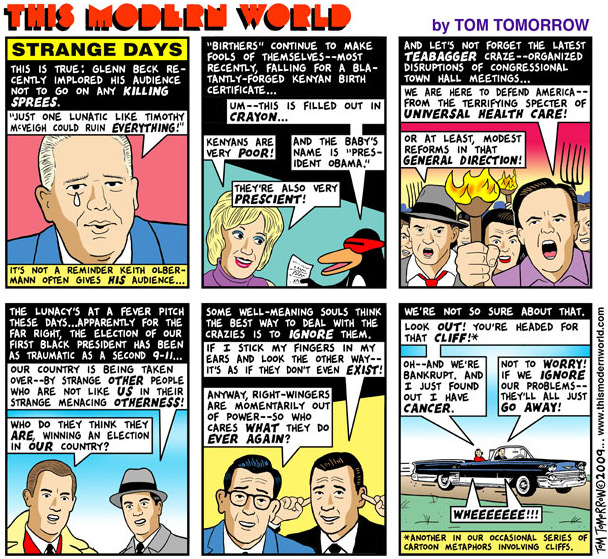
Today, however, I am writing about an issue that may inflame some of you and prove to be very troubling to others.  It’s not my goal to do either.  I’d just like to bring into focus the crazy stuff that seems to be taking us over, a kind of Bird Brain Flu that doesn’t have a vaccine and that appears to be enveloping our nation.

You see, it is my humble opinion that we as a country have reached a new low point in dumbness.  The wild, inflammatory rhetoric, a/k/a crazy talk that’s being spouted every day, appears to be pushing the fringe players out from under their rocks and their basement fortresses.  This political flu is taking us to levels of foolishness  that are so low that even a Limbo expert couldn’t fit under the broom stick.

Tomtomorrow_GlennBeck_

Have you noticed how open public hatred and outright prejudice has become?  It’s like we’re living a rap song from Gran Torino. Each and every day we hear the ranting of media talking heads leading the charge to endorse this movement.  For those of you who have read my work over the past few years, you know that I personally am repulsed by bullies, by racists, and by those who believe they are superior to other human beings.

The new accusations and sick suggestions that are the current craze are veiled as protests regarding big government, health insurance reform, and a lack of confidence in the ship of state.  What they really seem to be, however, is fear and lack of tolerance for our President.  So what if you don’t like him?  There still have to be some limits and boundaries. Are there any more lines?

I’m telling you, the crazies are coming out from their caves.  Seriously, watch out for them.  Many of these radicals are great examples of why some animals eat their young.

Just last week on a trip to Washington D.C., I had to be evacuated from the Pittsburgh airport because a passenger was carrying a defused hand grenade in his suitcase.  What is the single thought that must be in the mind of any individual who believes that a weapon, even, as it turned out, an inert one, such as that grenade, would be okay to pack for your plane ride?  Let me guess.  That thought was “Duh?”

It seems that every time some poor innocent gets shot in this country, there was some fringe individual who believed that he was not only given permission to take their life, but that there was an overwhelming endorsement of his actions that would somehow vilify him from any prosecution, and reward him with glory.  Does that sound like the Jihadi 72 virgins thing to you?

Yes, we have freedom of speech.  Yes, we have the right to bear arms, but do we have the right to just be nuts in public?  Maybe instead of statins in the water system to control cholesterol, or fluoride to prevent tooth decay, we should start putting Zoloft or some other  selective serotonin reuptake inhibitors (SSRIs) in that keep the brain from becoming unbalanced.

kids_group

What’s wrong with love, kindness, and the golden rule, of doing to your neighbor as you would have them do unto you? Can’t we look for compromise without demonizing those with opposite views?

Can’t we stop endorsing or even worse stop inflaming those with extreme views?  When is enough enough?  When will we return to civility, to compromise, and to brotherhood?  Would you rather have peace, love, and rock ‘n roll, or “Go ahead. Make my day, @#%&+^@#”?

Share

On Data Breaches

September 4th, 2009

About two years ago, I had a call from my local bank asking if I had purchased a washer and dryer… in Barcelona, Spain. Somewhere, someone had gained access to my credit card number, and used it illegally for that  purchase overseas.

It was not too long after that that another bank informed me that my card had to be canceled because of a data breach at a national chain store where I had purchased some clothing. (I have since come to learn that this data breach has already cost their parent company over $220M.) Then, a few weeks later, another card had to be canceled and re-registered.  Finally, about three months after that, restrictions were placed on still another set of cards due to similar, but entirely unrelated breaches. Three cards, three banks, multiple breaches …and my wallet was still firmly tucked in my back pocket.

Joe Carberry / David Chamberlin / FORBES magazine - data breaches - NickJacobs.org
In a recent article in Forbes Magazine, the facts and figures of this new, growing phenomena were outlined statistically so as to begin to bring some sense to the table regarding what we are facing.  The authors, Joe Carberry and David J. Chamberlin state that “Only 36% of C-level executives are confident their organizations will not suffer data breaches in the  next 12 months.”

As healthcare gears up to go completely electronic, we must remember that there are, for all practical purposes, entire countries dedicating serious efforts to breach the United States data banks.  Hackers are no longer  identified as stereotypical, 98 pound computer savants.  Many of them are professional criminals and terrorists.  As a former CEO, I always had to be cognizant of the risk, then do whatever we felt we could afford to do to help mitigate that risk.  Rarely, however, have I seen any type of comprehensive commitment to a comprehensive, multi-faceted approach to this effort.

computer security1_220The laws that address data breaches involve not only civil but also criminal penalties, and the individual laws of various states are most times very different.  It doesn’t matter if your business is located in only one state. What matters is where your customers are from, and if they are a diverse group, you must comply with each

state law regulating breach notification.

SunStone Consulting, LLC, and Immersion Ltd., through their InfoLaunch suite of products, are positioned to assist you to prepare for any type of breach.  As Carberry and Chamberlin state, preparation must involve not only legal, but also communications, the C -suite, and risk management.  They further recommend the following steps:

1. Be prepared

2. Move quickly

3. Take action, and

4. Be responsible.

The  professional reputation damage that could be encountered by the hospital or physician practice that is not responsible, not prepared, slow moving, and not action-oriented can be devastating.

Are you prepared?

Share

Nine Trillion Dollars in the Hole?

August 22nd, 2009

Let me be the first to admit that I was and am all about change. Change has been the only consistent thing in my life.  Today, however, when the deficit projection was revealed to be nine trillion dollars over the next ten years, my non-economist mind began to wonder where this is all going?

My son-in-law is coming home in the next several days from a one year deployment that saw him in harms way in Iraq for the last eight months, and now we all sit with our fingers crossed that we will not be facing a similar deployment not too many months from now to Afghanistan.

How does one maintain two wars, keep soldiers stationed post-World War II in Italy, Germany, and Turkey, to name a few, and in South Korea plus continuing to remain in Iraq, and now push more and more into Afghanistan without bankrupting this country?  Is it possible that very very smart people are not capable of figuring out that in a down economy, the finances will continue to go south until we are, like the USSR in the Cold War, going broke?

When do we begin to see that the previous several administrations lead us into a mindset of borrowing against our future to the extent that we may not have a future, and when will we say, “Okay, enough, let’s stop feeding trillions into wars, and start trying to figure out the rest of this economic equation?”  It clearly is no longer a war on terror, but what is it?  If it is an economic war intended to create jobs a.k.a., the argument for or against the F-22 cuts, can’t we find a better way?

health_debate_specterThe people who seem the most upset about the health care debate are clearly the people who have healthcare, and the people who are least likely to speak out are the young women and children who have no coverage.  Not only will they not speak out, they also don’t, for the most part, vote.  If anyone believes that we are not in some way paying for the 46 or 47 million uninsured now, they are clearly delusional.  Ask a hospital CEO how much the facility charges for an aspirin or a Q-tip.  It’s not because these items cost so much more in a hospital setting, it’s because there is not enough money to go around when patient after patient presents at their doors without healthcare coverage.

We have acquiesced to AIG, to the very large banking institutions, to the automobile manufactures, and to numerous major financial houses.  We have placed billions of our tax dollars into their hands and have watched as their CEO’s, like that of AIG, continue to make millions in salaries with millions more in bonuses.  We have continued to wage wars that were clearly called “Republican Wars” during the last administration, and have no name now.  And we are watching our Social Security and Medicare accounts dwindle more quickly than anyone could ever have imagined.

Far be it from me to take a political stand on such complex economic matters, but it does seem very certain that our futures are tied inextricably together and, unless we slow down our expenditures, find ways to be more fiacally responsible, and, take care of our fellow man, we seem to be heading down a very destructive path.  Alan Greenspan’s admission of missing the economic targets of not too many years ago rings in my ears as he said, “I underestimated the greed.”  Maybe we have all underestimated the greed for too long.

As a professional giver of advice, let me conclude by saying that we can make this work. We can pull back the reins, slow the spending, and still move the economy.  It’s no different than managing our own personal economics; live below your means, save, take care of the necessities, and realize that not all belts can wrap around a 44″ waist. But all of this takes some serious discipline, something that our leaders seem to have been missing for a very long time.  We can’t continue to talk our way out of trouble;  serious, positive action is the key.

Share