I Remember Stephen

June 2nd, 2010 by Nick Jacobs 6 comments »

In the 1970’s, my career was wrapped completely around teaching, not just teaching, but teaching and playing music.  It was during that decade that my trumpet playing reached its peak, and between the numerous big bands in the area, I could play at least two weekend and one weekday nights every week.  The music was good, the musicians were friends, and the audiences were appreciative.

Johnstown Pennsylvania - A History - Part 2 - Randy WhittleThe Lemon Drop, Casa Romani, Mynderbinders, Bimbo’s, the Holiday Inn, the Ramada Inn, and a dozen other clubs with mostly ethnic or fraternal names were the sites of many a part-time playing job.  Be it the Johnstown Jazz Workshop, the Barnum and Bailey Circus, the Ice Capades, or Disney on Ice, my playing salary for the year often rivaled my teaching salary; neither of which came to more than $500 a month.

Along with those playing “gigs” there was one other primary, part -time employment opportunity and that was teaching private trumpet lessons.  It was my choice to teach at the Johnstown College of Music which was owned by Peg and Bob Hornick.  My schedule there was always packed full from 5:30 PM until 9:00 PM Tuesdays, Thursdays, and Saturday mornings.  There were kids of all ages from all school districts, and in the 1970’s those kids helped me pay the mortgage.  Even though I was usually pretty tired by 9:00 PM and often dreamed of learning to sleep with my eyes open, I never did.

One of my smallest students was Steve.  He was a little toe-headed, 7th grader from Forest Hills when he came to me, and he loved music.  He loved the fact that he was learning to play the trumpet from a professional and each week he got a little better.  Steve understood what it meant to work for something that he loved, and he didn’t mind getting an occasional tongue lashing if he hadn’t focused enough on his practicing that week.

Well, one night in 1976, I rushed through dinner, grabbed my jacket, and started for the door when my son, then three years old, stopped me and said, “Daddy, where are you going?”  I explained that I had to go to work.  He very slowly replied, “Daddy, you just came home from work.”  I signed and said, “I know, buddy, but I have to make some extra money.”  He looked at me quizzically and said, “What for, Daddy?”   To which I countered, “To buy you shoes.”  At that point he looked up at me and said in a very stern voice, “Daddy, I have shoes; please don’t leave me.”

It broke my heart to leave that night, but I did because I knew that I had an obligation, and when my first student walked in the door, I took a deep breath and thought to myself, “Steve, I’m here for you tonight, “ but those words were never spoken.
Ironically, there was an obituary in the newspaper last week, and it was an obituary for a 47 year old man who also left behind a son.  The age and the picture drew me further into the printed word where I read a name that seemed strangely familiar to me, Stephen Yanzetich.  It was Steve, my Steve, little 7th grade, toe-headed Steve who shared me that night.

Unbelievably, after 34 or so years, in his parting recognition, the author acknowledged that I had taught Steve trumpet, and as I sat back and read my own name in that obituary, I realized, once again, that it had been worth it, that 34 years later my time with Steve had been important to both of us.  That simple acknowledgement said to me, “Thank you, Mr. Jacobs, for caring enough about me to teach me all of those nights.”  To which I can candidly reply,”Thank you, Steve, for being such a good kid, and may God bless you.”

Share

Moving Through Healthcare’s Version of the BP Oil Spill

May 27th, 2010 by Nick Jacobs No comments »

Who could have ever guessed that the United States of America would fall so far behind in education, childhood death statisticsscientific research, manufacturing jobs, and even overall, general healthcare?  Yes, of course, we are still a wonderful, strong country with incredible resources, but somewhere along the line, the train seems to have jumped off the track just a little, or is that like being a little pregnant?  No one would ever have conceived that a spark plug would be worth more than GM stock, but that’s exactly what happened last year.  Or how about the fact that large investment banks responding to the mandate to increase home sales by spreading the risk internationally could have helped put this entire world on the verge of a national depression?

For years now I’ve written about the need to provide some type of safety valve for the uninsured, underinsured, and those struggling to make it from layoff at age 58 to Medicare at age 65.  Not unlike the Kennedy-Katzenbaum bill, (you know, that HIPAA bill that was just meant to provide health insurance portability), we have healthcare reform legislation.  The really challenging thing about this new bill is that it was primarily written by policy wonks fifty percent of whom will not be working in Washington D.C. in a few years, and worse than that, it will be interpreted by policy wonk lifers who will be there long after we are all dead.

So, the “Healthcare Oil Spill” has been addressed.  What will it mean?  What does it mean?  How will it impact all of us?  That remains to be seen.  The good news is that 30 million more people will finally have a safety net. The bad news is that there are still two wars going on that are draining our treasury.  There is still financial chaos among the countries lovingly referred to by the EU as the PIIGS (Portugal, Ireland, Italy, Greece, and Spain), and, along with this group,  spending in the United States  has been out of control for at least nine years.

What will happen is anyone’s guess.  How things will be interpreted is anyone’s guess.  How the law will be enforced is every one’s guess, but in  a recent round table discussion at the Mid-State HFMA meeting, we heard four CFOs discuss the challenges that they currently face and will continue to face as life becomes even more complex.  After that session, I’m thinking that lots of mud pushed in the head of the well might just be the cure!  Goodness knows there was enough mud thrown around during this last election cycle.  Maybe we could redirect it back to the source?  I do know for sure that one thing is clear: CHANGE is INEVITABLE, the train is back on the track, and it’s coming straight toward our physicians, hospitals, and nursing homes.

How do we cope with that change?  Make sure that every ounce of fat is cut from the system.  Take a look at the list below and contact SunStone Consulting for the next steps:

Share

Speaking This Year

May 20th, 2010 by Nick Jacobs 15 comments »
Nick Jacobs, FACHE - F. Nicholas Jacobs - Healing Hospitals - Sunstone Consulting

Nick Jacobs, FACHE

As some of you may have noticed, last year was a tough year for education, travel, and some forms of consulting. It was “the economy, stupid.” A number of our major public speaking engagements were canceled or postponed, because hospitals stopped sending employees to educational conferences. In fact, at one of the leadership conferences where we spoke last year, there were only 90 people in attendance. The previous year, there had been nearly 500.

Well, thank goodness, things have picked up a bit, and we will be speaking a few more times over the next several months. The following is an up-to-date list of locations, dates, and topics currently scheduled:

  1. Lake Erie Regional Cooperative/Amerinet Conference, Toledo, OH, May 7th, 2010
    “Redesigning the Patient Experience”
  2. Risk Management and Patient Safety Institute, Lansing, Michigan, August 27, 2010
    “Blogging and Transparency -Increasing Patient Satisfaction through Web 2.0”
  3. Planetree Conference, Denver, Colorado, October 8th, 2010
    “Navigating the challenges faced while transitioning to the Planetree model of care”
  4. Central Peninsula Hospital, Soldotna Alaska, October 14, 15th
    “Planetree”
  5. Waverly Health Center, Waverly, Iowa, October 20-22,
    Topic: To be announced
Share

IBRF – The International Brain Research Foundation

April 23rd, 2010 by Nick Jacobs 102 comments »

Popular Science in their March 2010 Edition published an article entitled “Waking Up the Brain Dead.”  the sub-title read “A Cocktail of Therapies Jump-Starts Patients’ Brains.”  Then, the May 2010 Ladies Home Journal is publishing an article entitled, “World Leaders in Translational Clinical Research for Alzheimer’s Disease,” (The International Brain Research Foundation – IBRF; in November of 2009, The Clinical Neuropsychologist published an article “The New Neuroscience Frontier: Promoting Neuroplasticity and Brain Repair in Traumatic Brain Injury” that was co-authored by at least two members of the IBRF, Dr. Philip DeFina and his associate Dr. Rosemarie Scolaro Moser, regarding the future of treatment for Traumatic Brain Injury (TBI).

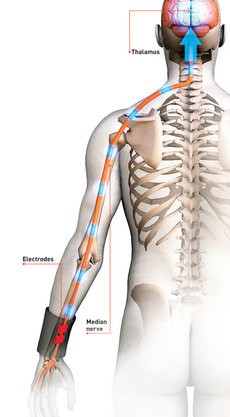
Philip De Fina, M.D.With an 84% success rate in waking up patients from deep, irreversible, persistent vegetative state comas traditional neurologists, neurosurgeons, and neuroscientists have called these “wake ups” flukes, but once you have nearly 45 flukes, the question becomes, “Are they real?”  As the Popular Science article states, Dr. DeFina and his team apply already approved medications, electrical stimulation, and nutraceuticals to the patient, but they do it in a virtual cocktail that has had a dramatic impact on these patients.

After having spent several days working with the folks at the International Brain Research Foundation, my personal heart strings began making their own music.  Not unlike the work that we did at my previous employer, DeFina’s Research Foundation is blazing new trails, not necessarily by inventing all new methodologies, but by applying new approaches to  well-established and FDA-approved drugs and protocols.  They are making unbelievable progress with highly nuanced protocols that will potentially change neuroscience forever.

In typical “small science” fashion, the traditional approach to these patients has been to apply one protocol at a time, and when that fails, move on to the next.  Dr. DeFina appropriately points out that this unconventional approach is effective because it goes to the source of numerous highly complex brain centers.  He asked me to imagine the Wright brothers trying to fly an airplane one “part” at a time.  “Orville, do you think this propeller will fly?”  Of course, that concept is absurd, but that is an appropriate description of how  Traumatic Brain Injuries are currently addressed.

Image from Popular Scince -  Waking the Brain DeadNearly a dozen years ago, when we were beginning our work at the research institute, it was obvious that the reason that cancer had not been cured was because science takes a very laser-like approach to everything;  let’s call it small science.  When we determined that we should have a pristine, highly-annotated collection of specially-collected breast tissue, that we should have a central data repository, and that, heaven forbid, we should have ensemble-type multi-disciplinary teams of scientists and MDs working together, it was as if we had suggested that all science be trashed.  It was so controversial.  To think that one scientist did not keep total  and complete control over all of the data generated by his work.  It was heresy.

Bottom line?  I believe that the International Brain Research Foundation will have us rethinking our living wills not to many years from now as they continue to awaken deep, irreversible coma victims and help them find their lives again.   Not unlike the activities at the Windber Research Institute, where the “Platinum Quality Tissue” is currently being used to map the breast genome.  We are looking into the future of science, and it is very exciting indeed.

IBRF Banner - Dr. Philip De Fina - Nick Jacobs - HealingHospitals.org - Sunstone Consulting

The very difficult news is that the IBRF is totally and completely dependent upon donations and grants for their work, and traditional granting organizations do not favor nontraditional approaches to curing disease and saving lives.   So, after you do your due diligence, if you are as moved as I was, check out the IBRF’s website (including their excellent videos) at www.ibrfinc.org, and help them change history.

For further reading:

Share

Jacobs in Wonderland

April 16th, 2010 by Nick Jacobs 6 comments »

Back in 1969, a famous singer by the name of Peggy Lee came out with a song entitled, “Is That All There Is?”  She sang about her lifetime experiences of having her house burn down, having attended and then realizing that she hated the circus, and then being dumped by her boyfriend.  After each one of those experiences she would sing, “If that’s all there is my friends, then let’s keep dancing.  Let’s break out the booze and have a ball.”

This song could only be described as a “downbeat song of disillusionment.”  It probably contributed to the creation of most of the new antidepressant drugs that we have today.  Now that was  a wonderful contribution to society that evolved that even Peggy could never have foreseen.  So, for an optimist, one must dream that “from trials and tribulations good things may happen.”  Or, if you’re the head of a pharmaceutical company, you might say, “from depressing songs we can make billions of dollars.”  (It’s a joke …relax.)

Truthfully, we all spend time each day kicking away the many disappointments that come at us as we work our way through the myriad speed bumps that come up during our own personal journeys.  This week was a week of observation for me.  I spent time observing what is going right and what is going wrong at all levels: personal,  business, national, and international for friends, fellow employees, relatives, other loved ones, companies, and politicians.   During my periods of reflection it became clear to me once again that “change is inevitable.”  In fact, change is life and life is change.   Those who can embrace it, deal with it, and make the best of it seem to thrive.

Leland Kaiser - Healthcare Futurist - Nick Jacobs, FACHE - Healing HospitalsThe challenge for most of us seems to be that of being able to get ourselves into harmony with what we want. Some days we have good thoughts, then not-so-good thoughts, and then the next day good thoughts and so on.  It has become clear to me that we need to reach a permanent state of believing without any doubt in exactly what we want to have happen.  Then, not unlike those 10,000 hours that I practiced my trumpet, it a matter of sticking with it until you get better and better at creating your own destiny, designing your own future.  Because as Leland Kaiser has said over and over again, “The Future is a Design Function.”

Dr. Denis Waitley, a positive mental attitude psychologist for the U.S. Olympic team, often speaks of positive self talk, but more importantly, he speaks of taking positive action. If  you don’t like what is happening, work to change it, but first you need to dig deep down inside yourself and determine if it is because you are truly offended by what is happening or if it is just change itself that you resent or fear.  Positive energy is not a “Jacobs in Wonderland” phenomena.  Rather, it is the movement that brings good things to life.

So, embrace healthcare reform as you try to figure it out.  Embrace nuclear arms reduction.  Embrace the fact that you are stranded in Europe because of a volcanic cloud.  It’s all good, or at least we can make it all good.  As long as we have life, love, and a will to succeed, it’s all good.  And, Peggy, the answer is, “No, that’s not all there is.”

There is nothing more fulfilling than living a purpose driven life, than contributing to the betterment of mankind in some meaningful way.   As I work with the International Brain Research Foundation to help them find support to bring traumatic brain injury (TBI) patients out from what were previously believed to be deep, irreversible comas: as I work with the fine people in breast cancer research to spread their work internationally; as I work in Patient Advocacy, and in finding resources for hospitals and physicians to enable them to provide even more superior care, I can tell you that “That’s not all there is.”   In fact, it’s just the beginning.

Share

So “Radical” Was the Correct Term?

April 8th, 2010 by Nick Jacobs 4 comments »
In 1987, my healthcare journey began in administration by asking the question, “Why are hospitals the way the are?”  It was a sincere inside/out question that had evolved from my having been a teacher, executive director of an arts organization, president of a convention and visitors bureau, and finally a PR/Marketing and Development professional in the world of healthcare.  By 1997, my ideas had been rejected so many times by so many traditional hospital administrators, who were either my bosses or my peers, that it felt like they would never come to fruition in a conservative field where change is sometimes seen as both life and job-threatening.
butterfly metamorphosis
In 1997, that all changed when Ernst and Young evaluated the hospital where my presidential appointment had just occurred and predicted the closure of that facility due to lack of population, lack of “financial depth” (a.k.a. cash), and a health system partner that successfully was eating our lunch each and every day. It was with that information in hand that I began the metamorphosis of this organization. The presentation to the board and medical staff was relatively simple:

“We can keep doing what we are doing, and then board the place up… or we can grow by changing  the way healthcare is delivered.”

No workplace bullying - Nick Jacobs - healtinghospitals.comLuckily for me, my board chairman at that time was a risk taker because, realistically, our backs were against the wall.  So, we began a journey of change.   We removed bullies from the workplace (both physicians and employees); created a homelike environment where you did not have to leave your dignity at the door;  added bread baking machines, popcorn machines in the lobby, decorative fountains, aroma therapy, massage, humor, music, and pet therapies.  We focused on Green, focused on Dignity for employees and patients; focused on providing a peaceful, loving, and Healing Environment; focused on Family Spaces; focused on Architecture; and focused on Quality of Care.  We began classes for our employees in Hospitality in Emotional Intelligence Quotient training and embraced ideas garnered from places like the Ritz Carlton, Disney, and Dale Carnegie.  Then we established an employee evaluation system that embraced these changes and rewarded our staff financially for their work.

Loved ones were encouraged to stay 24/7 as visiting hours were opened to them, double beds were placed in the OB suites, a wellness/prevention/and integrative health facility was built to embrace not only traditional therapies but to an entire gamut of alternatives.  A senior citizen center was condominiumized and made available to the Area Agency on Aging.  We had patients help us design a new Palliative Care Unit, Breast Care Center, and Fitness facility, then finally we added a world class International Research Institute.

That was 1997 through 2008.  It appears from the posting below that the world is beginning to consider some of these ideas, but lo, these many years later, they are still being referred to as “radical.”  Well, if any of you are interested in how to do what we did which tripled our organizational budget in size and doubled our workforce,  just give me a call at 412-992-6197, to participate in this program.

Obviously, Windber, Pennsylvania was where this movement all started.   Let’s make sure that it doesn’t stop.  After all, it’s not what people like.  It’s what people LOVE.

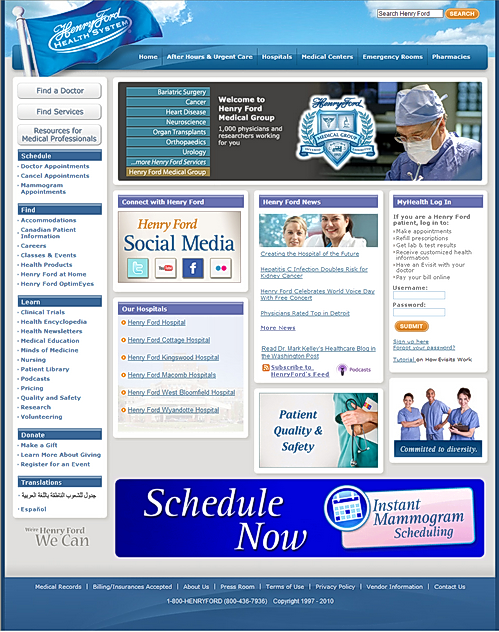
Henry Ford Health System - Nick Jacobs, FACHE - HealingHospitals.com

Henry Ford Health System Goes Radical: Creating the Hospital of the Future

DETROIT – Looking to shake up your industry, transform your medical center, and recharge your organization?

A two-day educational symposium, “Going Radical: Creating the Hospital of the Future,” may hold the key to revitalization. It will be held May 25 – 27.

Henry Ford Health System President and CEO Nancy Schlichting will share her radical, but practical strategies for success at the symposium, tapping into the wisdom of her top executives in an interactive session on the profound lessons learned during their tenure.

It was Schlichting’s brainstorm to hire a CEO for Henry Ford West Bloomfield Hospital from outside the healthcare industry. Her choice was Gerard van Grinsven, a former executive of the Ritz-Carlton hotel chain, and an expert in service excellence.

Henry Ford West Bloomfield staff will discuss its successes in differentiating itself from the competition by:

• Constructing prototype rooms for planning and community input.

• Incorporating green features in the architecture and construction.

• Building all private patient rooms, including in the emergency department.

• Emphasizing wellness and healthy living.

• Combining traditional clinical care with complementary therapies.

• Creating a unique brand and inspiring staff to think differently.

• Including family space in each patient room, including intensive care.

• Implementing a new kind of food culture in health care.

• Putting a focus on the special concerns of the elderly.

Entrepreneur Bill Taylor, co-author of Mavericks at Work and co-founder of Fast Company magazine, will be the keynote speaker. His ideas have helped shape the global conversation about how business works and “why the most original minds in business win”. His next book, Practically Radical, to be published this fall, explores how to unleash big change in difficult times.

During break-out sessions Henry Ford staff will share lessons learned while juggling the building of the $360-million West Bloomfield hospital and the $300 million renovation of Henry Ford Hospital in Detroit.

Tours of Henry Ford West Bloomfield Hospital will include a visit to the Emergency Department, wellness center, and an inpatient room. At Henry Ford Hospital, participants will tour the Center for Simulation, Education and Research – one of the largest facilities of its kind in the Midwest that provides hands-on training with medical mannequins.

Symposium sessions include:

• Creating a Culture of High Performance
• Facility Innovations Through the Eyes of the Patient
• The Best of Both Worlds: Clinical Excellence Meets Integrative Medicine
• Transforming Hospital Food
• Radical Outreach: Relationship Building to Win Over the Community and Recruit Staff
• Thriving in Detroit: A Blueprint for Transforming Your Hospital System and The Physician Perspective

each and every day.  It was with that information in hand that I began the metamorphasis of this organization.  The presentation to the board and medical staff was relatively simple, “We can keep doing what we are doing, and then board the place up, or we can change the way healthcare is delivered and grow.”
Share

What’s Still Missing?

April 3rd, 2010 by Nick Jacobs 6 comments »
We are on a not-so-merry-go-round which, even after health care reform, continues to promote a system of illness incentives  that are improperly reimbursed, improperly addressed, and inappropriately segmented. We continue to consider body parts as if they are not connected to or a component of the whole.
Wellness Wheel - Image credit: Marquette University

Tort reform still has virtually no teeth.  This causes physicians to practice sometimes over-the-top medicine in self-defense. When will it be time to begin to throw the switch and teach patients what we already know so well; that wellness, wholeness, and health can change the quality of our lives completely? Our medical schools need to embrace wellness and prevention as a path to health. Not unlike indigenous man, it is time that we begin to realize that our brains do have something to do with our bodies.  We live in a commodity driven society which does not always promote the best, most healthful food, even miminal exercise, stress management, or self-nurturing. Instead, because of those quarterly reports to the stockholders, these companies promote what is the most lucrative and often the easiest to sell.

Oprah.com - Health and Wellness - Nick Jacobs -  HealingHospitals.comWe know that drinking a soft drink with 10 teaspoons of sugar is not healthful. We clearly understand that quadruple cheese anything might eventually catch up with us, or that Uncle Buck’s 72 oz. steak can’t really be good for our arteries. Fried and buttered everything, a total lack of exercise, and more stress than anyone can ever dream of will not extend our lives

One night a few weeks ago I couldn’t sleep, and at 3:00 AM, I looked up and saw an apparition… Oprah. There she was, talking about food. The person she was interviewing said, “Oprah, in the 1960’s, our food cost us 18% of our annual income. ” Maybe that’s why there weren’t more restaurants at that time. Families were stretched just eating at home. He went on to say that, “In the 60’s, healthcare costs us 9% of our income.”  Finally he said, “Now healthcare costs us 18% of our income, and food costs us 9%.”

So, that’s the trade off. We can buy good, farmer’s market-type healthy, organic food and have low healthcare costs, or we can buy manufactured, additive filled food, and pay more for our healthcare.  How much further down this cul de sac must we go as a country before we begin to realize the path to health and wellness or longevity?

Health and Wellness - Nick Jacobs - HealingHospitals.com

Share

So, it passed. Now what?

March 22nd, 2010 by Nick Jacobs 2 comments »

The very essence of the fabric of our society has changed today and forever.  The questions that arise from the passage of health care  reform are endless in number and the answers will be both evolutionary and revolutionary.  Not unlike those dark or bright days following the passage of Medicare back in the 60’s, the naysayers are predicting the end of the United States and those individuals who will be positively impacted are finally able to sleep through the night without feeling the steady stream of their own tears flowing across their cheeks because they either couldn’t get care or couldn’t afford to pay for the care.

It is more than a cultural change, it is a humanity change.  The key to both, however, is the word change. Those who have wonderful, sustainable, well-financed lives with adequate health insurance are concerned that their hard-earned dollars will go to support an inefficient welfare sate.  Interestingly, many of these people clearly may benefit tremendously by these changes, but  they are unsure as to what that change will represent to them personally.

When Medicare passed, those who did not or could not embrace it quickly enough did have significant life changes.  On the other hand, those who could ended up doing better than they could have ever dreamed.  The same was true of the managed care movement of a dozen years ago. The real question here seems to be one of  “The Greater Good.”  Will it be worth it to help our fellow man?

The bigger issue in my mind is the question of our ability to shift from sickness to wellness care. Wellness and prevention, Tort Reform, Big Insurance, Big Pharma, were all part of the dance.  What will their involvement be in this new healthcare plan?  My insurance friends are predicting the end of their world. Will it be the end or just a different model?

What do we need to do to make it work?  We need to end two wars, decrease the DoD spending accordingly, and monitor those who abuse the system.  We still need Tort Reform. We need to reimburse our physicians for counseling their patients about wellness and prevention as well as for end of  life choices and options.

Telemedicine technology

In a recent article in the Harvard Business Review by Gardiner Morse, The Ten Innovations that will Transform Medicine, we see a stimulating list of opportunities that could make this all work better:

1. Evidence Based Decision Making
2. Payment Innovation (based on outcomes and volumes)
3.  Patient Portals for access to personal health information
4.  Behaviorial Economics
5.  Protocols that work for specific treatments
6. Accountable Care
7. Regenerative Medicine (incl. adult stem cells)
8. Virtual Visits  (telemedicine)
9.  Genetics
10.  Robotics

Regardless of your personal view of healthcare reform, it was clear that the system has been broken for a very long time, and whatever religion or spiritual belief you embrace, it has to be supportive of an effort that will potentially stop destroying the lives of others due to either a lack of available healthcare or a lack of finances.  Stay Tuned.

Share

Healthcare Reform. . . It’s only just begun

March 10th, 2010 by Nick Jacobs 11 comments »

This week’s Bloomberg Business Week magazine featured a phenomenal and very personal story of healthcare that actually captures many of the challenges around healthcare reform.  The author, Amanda Bennett, takes us on a journey that she has titled, “Lessons of a $618,616 Death.”  The true title, however, should have been, “How Do You Put A Price on 17 Months?”  In this article, Ms. Bennett takes us on the step-by-step, blow-by-blow journey that ended with her husband’s death.  She and a friend painfully reconstructed every page of his medical records, every dollar paid by her insurance companies, and every charge made by the various doctors and hospitals that treated him during the last years of his life.

Business Week end-of-life issue - Nick Jacobs - healinghospitals.com
Amanda Bennett and Terence Foley

She showed 1.) the grand total of charges, $618,616, 2.) the actual monies paid by the insurance companies to the hospitals after contractual negotiations, $254,176, and 3.) the total paid by her family, $9,468. In the article, she described the 30% overhead/administration costs, the costs of experimental drugs inside and outside of trials, and the 4,750 pages of medical records that were amassed during this time. For those of us who have “spent our time” trying to live within, cope with, and better understand America’s healthcare system, there were no surprises.  For those of us who have watched a loved one take this cancer journey with all of its mysterious unknowns, there were also no surprises. Ms. Bennett’s quote, “The system has a strong bias toward action,” was, I believe, the most poignant in the entire piece.

A few weeks ago, I had lunch with a very healthcare-savvy individual who, when I jokingly referred to death panels, almost came across the table at me.  She did not believe it was funny.  To say that she was passionate would miss the point.  Only the day before, I had spoken with another very intelligent healthcare reform advocate who indicated that the entire concept of death panels emanated from a payment code that reimbursed physicians for simply (or in some cases finally) talking to patients about their alternatives.  I had heard other explanations, but neither mattered.  What matters is that, in many instances, we are not discussing appropriate alternatives or revealing the quality-of-life issues often overlooked before beginning long courses of experimental drugs, or oncology drugs that may not have any positive impact on the health outcome of the individual.

Interestingly, Ms. Bennett did indicate that for all of the time, money, and pain invested in this journey, no one could confirm that her husband’s life was actually extended by these medical experiences.

Someone once described America’s healthcare system to me like this:  You walk into Nordstrom, order several three-thousand-dollar suits, a dozen shirts and some handmade, silk Italian ties, then turn to the person beside you and say to the clerk, ‘”He is paying for this.”  Our heroine Ms. Bennett did mention the fact that her husband would probably have questioned the use of all of these funds in this manner and the relationship that these expenditures might have had on all of the other people in the world who might have been helped by these dollars.

Taking the Hell Out of Healthcare by Nick JacobsWhen healthcare reform is discussed, it is personal.  It is also deep, and it is costly, but the bottom line always comes back to this: “How do you put a price on 17 months?”  In my book Taking the Hell out of Healthcare, I discuss the journey that my father and our neighbor took together over about a 17 month period.  Both diagnosed with lung cancer, my father decided to go for it all.  He had surgery, chemo, radiation, more radiation, and more chemo.  My neighbor, a man without significant health insurance coverage, decided to spend his time with his family.  They both died on the same day.  My father died in a cold, tertiary care hospital where no clergy was present, his family members were not all able to be there with him, and it was over.  In contrast, our neighbor died peacefully in his home, surrounded by his entire family.

Ms. Bennett did say that she was glad that she was not a bureaucrat having to deal with these issues.  Frankly, I wish that she was!

Share

Gotta Love This Guy (Oh, yeah, and this is an editorial comment)

March 1st, 2010 by Nick Jacobs 11 comments »

As we begin to emerge from the bottom of a V-shaped recession, we all pray that it does not evolve into a W-shaped recession. Having been a witness for the majority of this economic challenge rather than an officer in charge, I’ve observed several significant issues that have impacted the hospital industry.  They have included the downgrading of bonds, a serious lack of access to capital financing, cutbacks in elective surgeries and elective donations to our health care foundations,  All of which has resulted in a deep degree of uncertainty as to when  all of this will be over.

V, L, W, U or L-shaped recovery vs. recession

The fact that many of the economic practices that got us into this mess have still not been discontinued or are being reshaped into the newest version of the scam du jour does not bring peace of mind to the vast majority of us, a deeply concerned citizenry.  Add to that the billions and now trillions that we are committed to repay over the next several generations, and one has to wonder about the ability of our current political system to respond appropriately to these challenges.

Warren E. Buffett

Warren Buffett’s annual letter to Berkshire Hathaway shareholders criticized Wall Street executives and board members in a way that most of us would liked to have expressed, but which only Buffet could articulate. This is because his comments are clearly supported by his business acumen and investment skills.  He broadsided the leadership of Wall Street for failing to control risk and for avoiding  what very clearly should have been the “severe” consequences of these failures.  He chastised the bankers in particular for designing and implementing their own industry’s doom and then piling the losses onto investors, while they themselves have managed to maintain lavish lifestyles.

“It has not been shareholders who have botched the operations of some of our country’s largest financial institutions,” Buffett wrote. “Yet they have borne the burden, with 90% or more of the value of their holdings wiped out in most cases of failure. Collectively, they have lost more than $500 billion in just the four largest financial fiascos of the last two years. To say these owners have been ‘bailed-out’ is to make a mockery of the term.”

“The CEOs and directors of the failed companies, however, have largely gone unscathed…Their fortunes may have been diminished by the disasters they oversaw, but they still live in grand style. It is the behavior of these CEOs and directors that needs to be changed: If their institutions and the country are harmed by their recklessness, they should pay a heavy price – one not reimbursable by the companies they’ve damaged nor by insurance.”

With his sentiments firmly ensconced in my mind, I have to wonder about the current rounds of outrageous health insurance increases perpetrated upon the customers of many of our largest and most profitable insurance companies.  As a hospital CEO, I learned very early on that no matter how low we held our charges, those savings would not be passed on to the patients because the middle man controlled this aspect of the “business.”  Incentives are completely upside down in the system at many levels, and the political commitment to truly work toward meaningful change seems not only misguided but also seriously uninformed.

Blair House health summit, February, 2010

Bottom line?  We need to be heard.  We need to work toward systems that make sense: protection from catastrophic financial situations brought on by major illnesses or accidents, primary care that truly helps the patient manage their health challenges at a reasonable cost, and a complete change from a sickness-based to a wellness-based reimbursement system that is not dependent upon the insurance companies for the decision making proposition.

Sometimes right is truly black and white, and until we embrace palliative care, incentivize individuals for taking care of themselves, and deal with tort reform, progress will be only a delusion.

U.S. Health Care Reform Timeline: 1910-2010

U.S. Health Care Reform Interactive Timeline: 1910-2010

Click image above to view full-size, interactive timeline. (Will open in a new web browser window.)

Share